Why money keeps leaking, why Bitcoin didn't fix it, and what a ship built for the age of robots could look like.
A strange question
I want to start with a strange question: how are things on your ship?
Here's what I mean. Money is a ship we all live on. We work aboard it, we eat aboard it, and almost none of us ever think about the hull. For most of my life I didn't either.
That changed for me in 2013, when I got into Bitcoin. I found myself down in the engine room, so to speak, watching gauges most passengers never look at, and I could see something wrong with the ship we were all on. I still think the people in that engine room saw the problem first. I also think the boat they built to escape it can't carry everyone, and I'll explain why.
This essay is my attempt to explain the whole thing with one picture you can keep in your head: a cruise ship. I'll walk through why the ship leaks, why money ships have leaked before, why the first escape didn't work, and why most people still don't care. Then I'll explain why robots are about to make everyone care, and what a ship built for that world would need. It's long, but there are a lot of drawings, and every one of them is doing work.
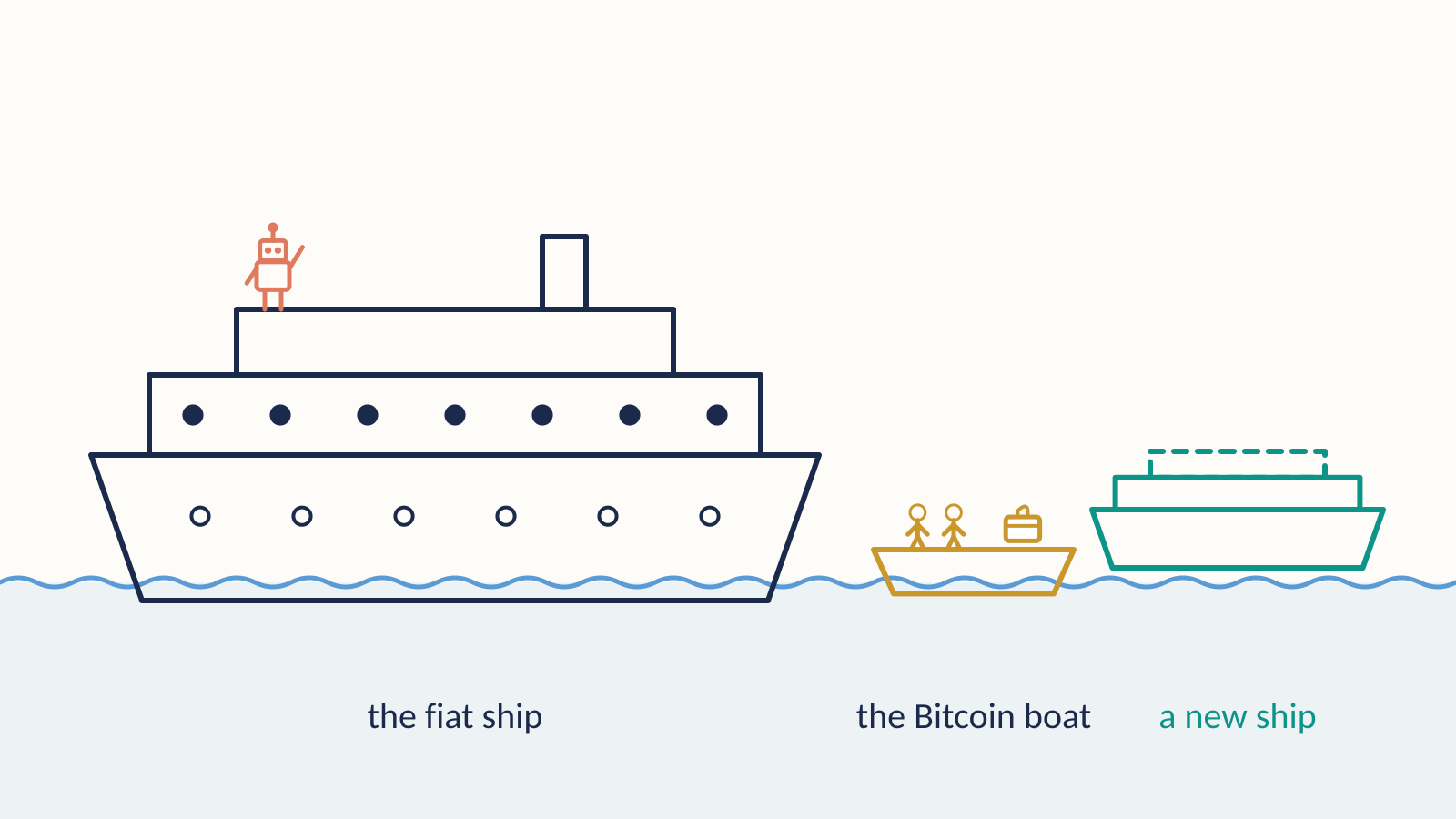
Sketch 1. The cast: the big ship we all live on, the boat the geeks built, and a new ship still under construction.
The ship we all live on
Picture a big cruise ship. Everyone aboard has a job. Some people cook in the galley, some clear tables, some keep the engine running, and some look after the kids in the kids' club. Let's say you work in the galley. You work your shift, and you get paid in ship credits.
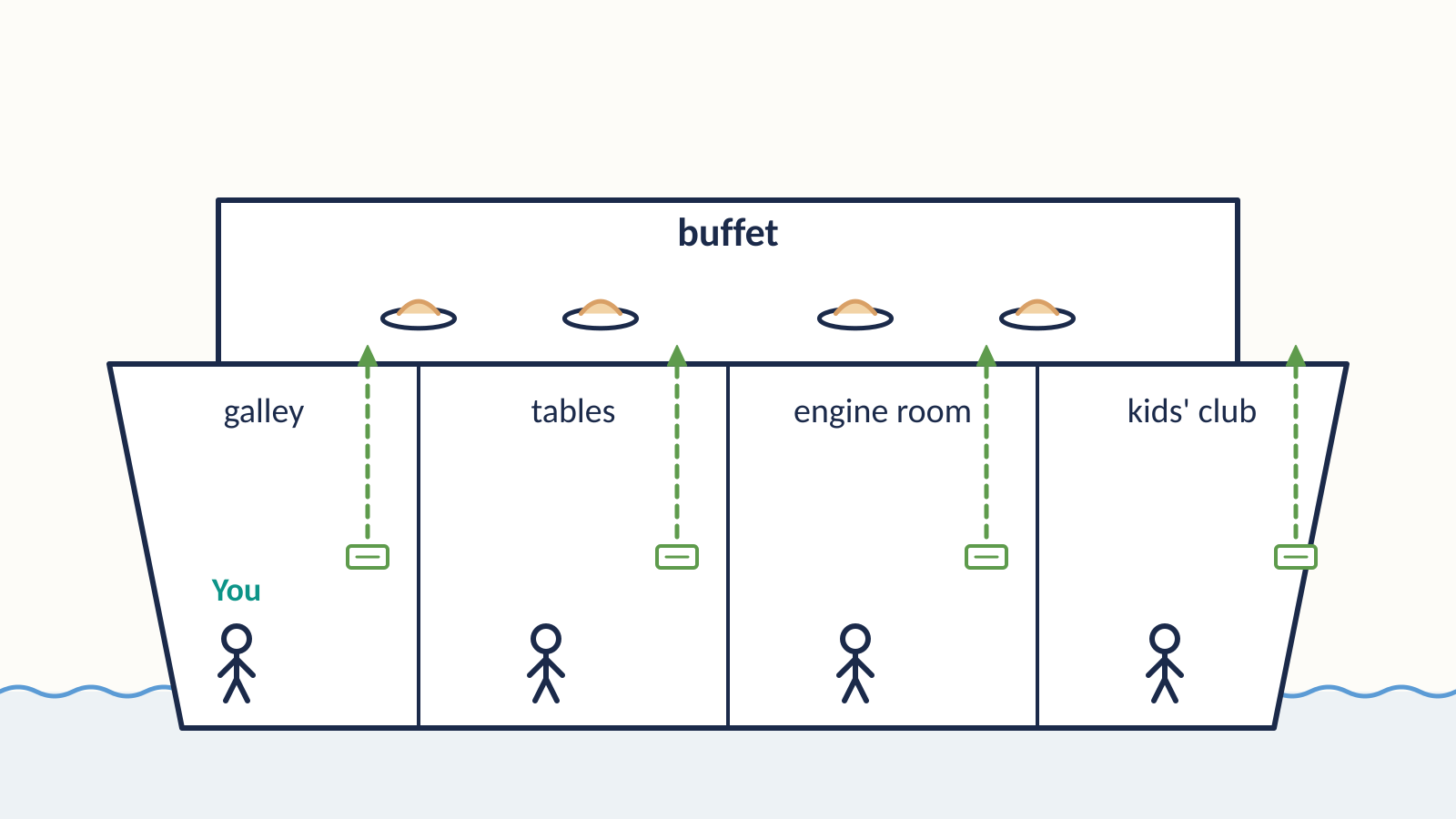
Sketch 2. Everyone aboard has a job and gets paid in credits, and the credits flow to the buffet.
Credits are how the ship keeps score. You spend them at the buffet, on a cabin, and on a deck chair by the pool on the weekend. A credit has no value by itself. It's a claim on what's aboard: the food, the cabins, and the work other passengers do for you.
That claim only works because everyone trusts it. When you accept credits for your shift, you're trusting that they will still buy dinner next week, next month and next year. That trust is the hull. Every plank is a little bit of shared confidence, and the whole ship floats on it.
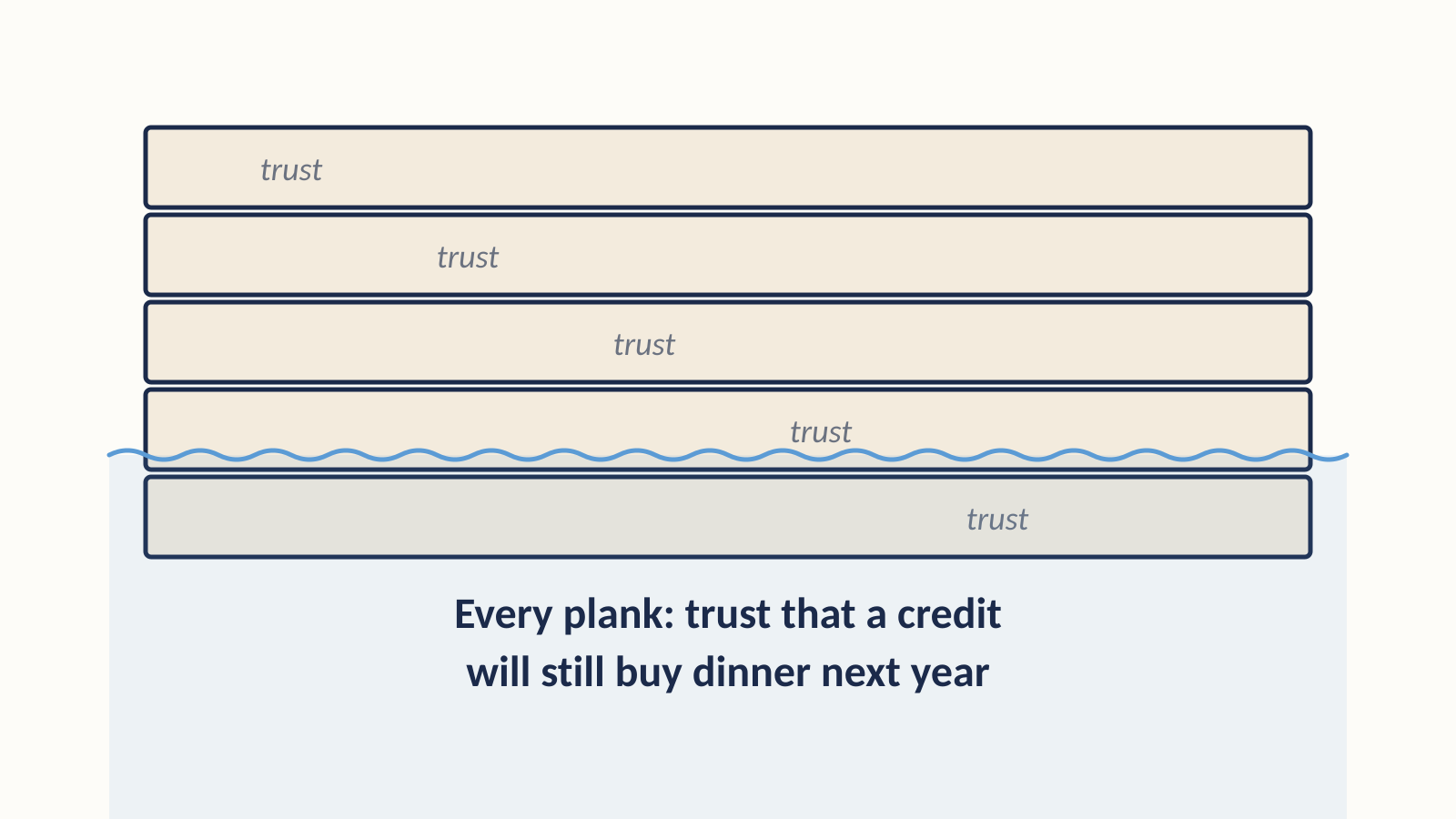
Sketch 3. The hull is trust.
Somebody has to decide how many credits exist, and on this ship that person is the Purser. He runs the credit office, and when the ship needs more credits, he makes them. He isn't a villain. He's usually trying to keep the ship running and the passengers calm, and a lot of what he does is reasonable. But he keeps a toolbox under his desk, and we'll come back to what's in it.
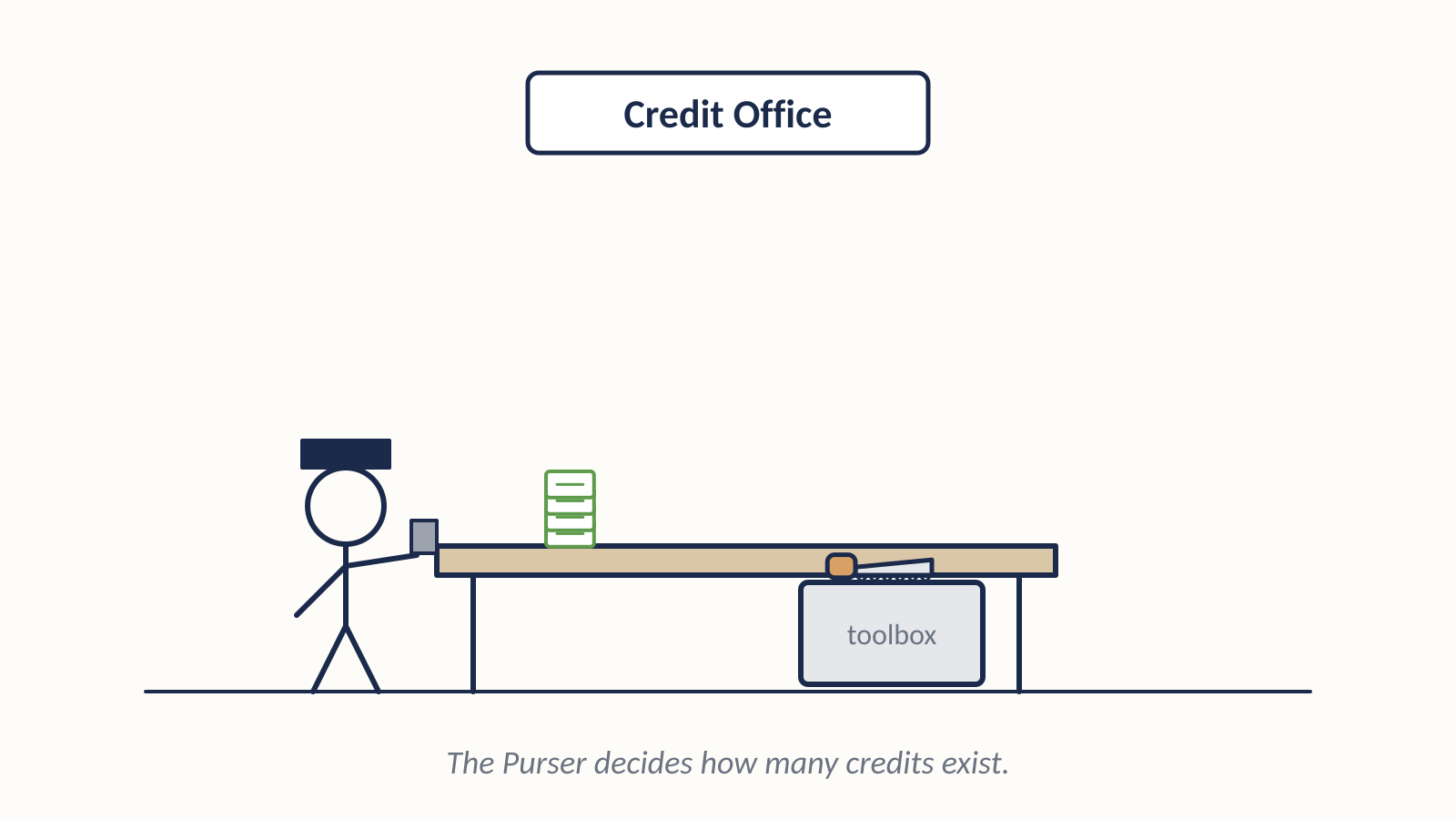
Sketch 4. The Purser decides how many credits exist. Note the toolbox.
Most of us never think about any of this, and it isn't because we're careless. It's because the ship floats. You don't inspect the hull of a ship that takes you to the pool deck every weekend. You notice the hull when your feet get wet.
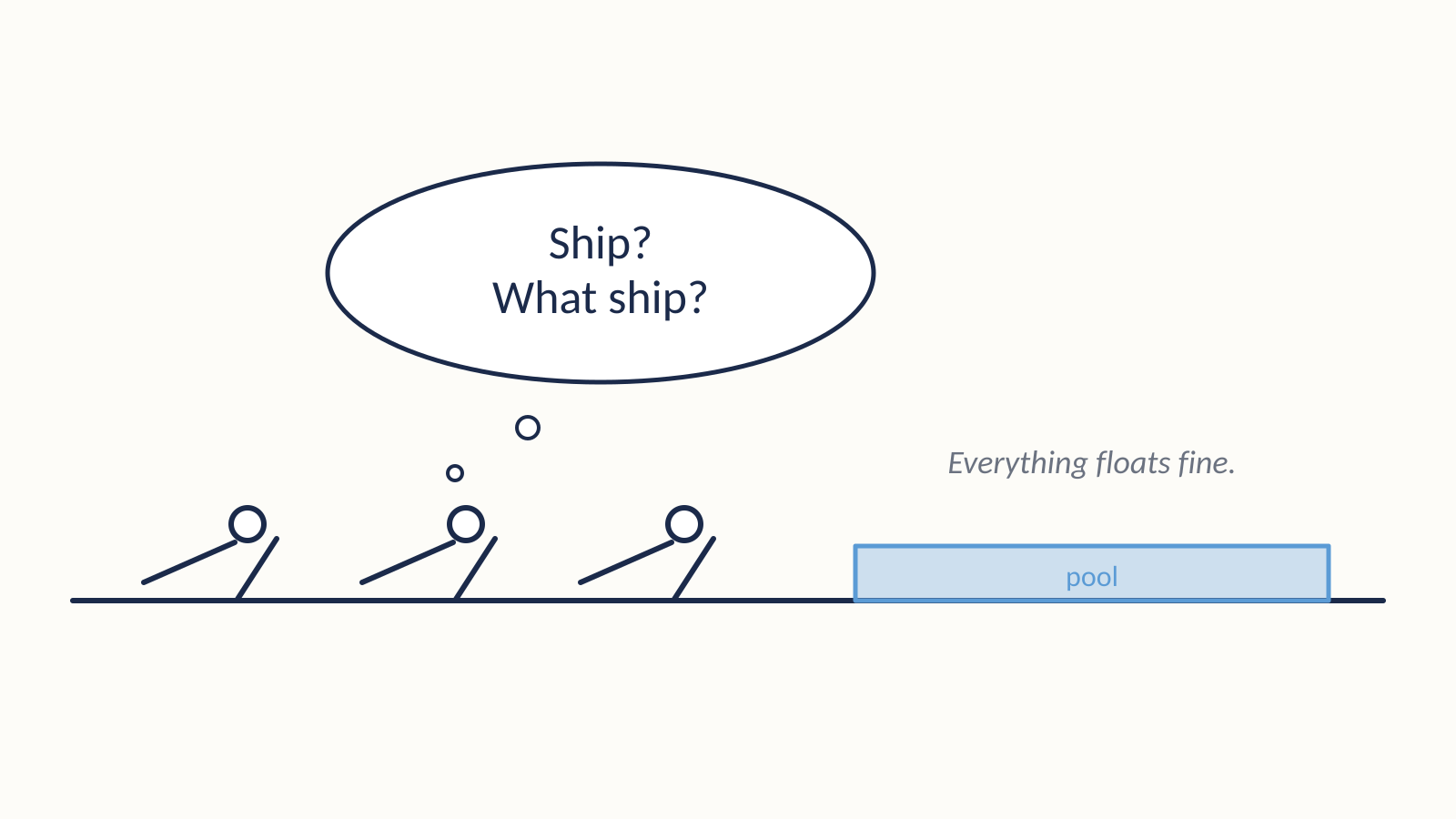
Sketch 5. Nobody inspects the hull of a ship that floats.
And the Purser has a saw
Here's the problem with this ship. When the Purser needs more credits, whether to pay for a project, cover a shortfall or calm people down, he doesn't find more food. The buffet is the same size it was yesterday. So he goes down into the hull with a saw, cuts out a plank, and turns it into credits.
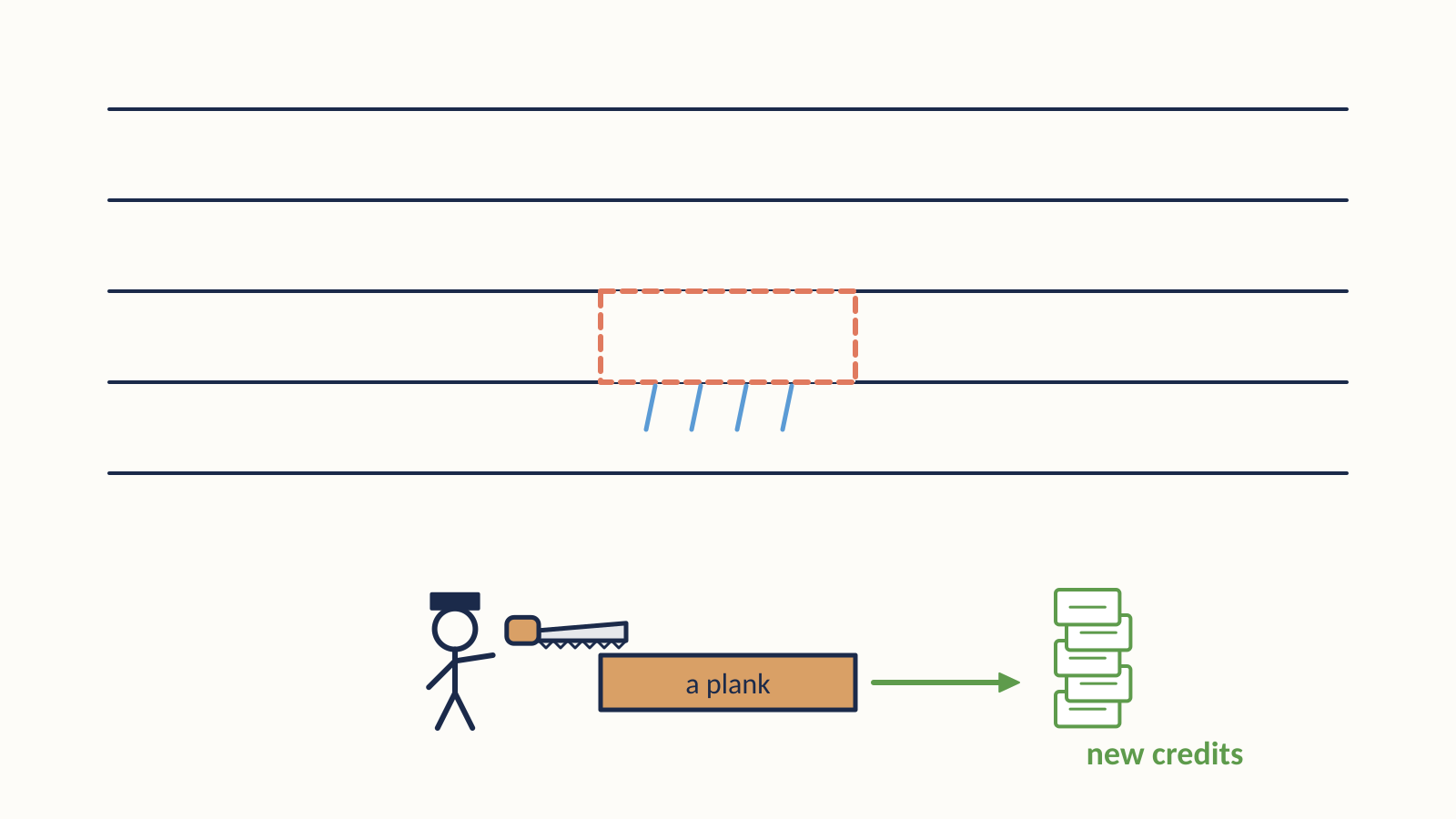
Sketch 6. New credits come from the hull itself.
That's the core of inflation, and it's simpler than it's usually made to sound. More credits are now chasing the same buffet. Nothing about the food changed, but each credit is a smaller claim on it, so prices go up. The plate that cost two credits now costs three, and eventually six.
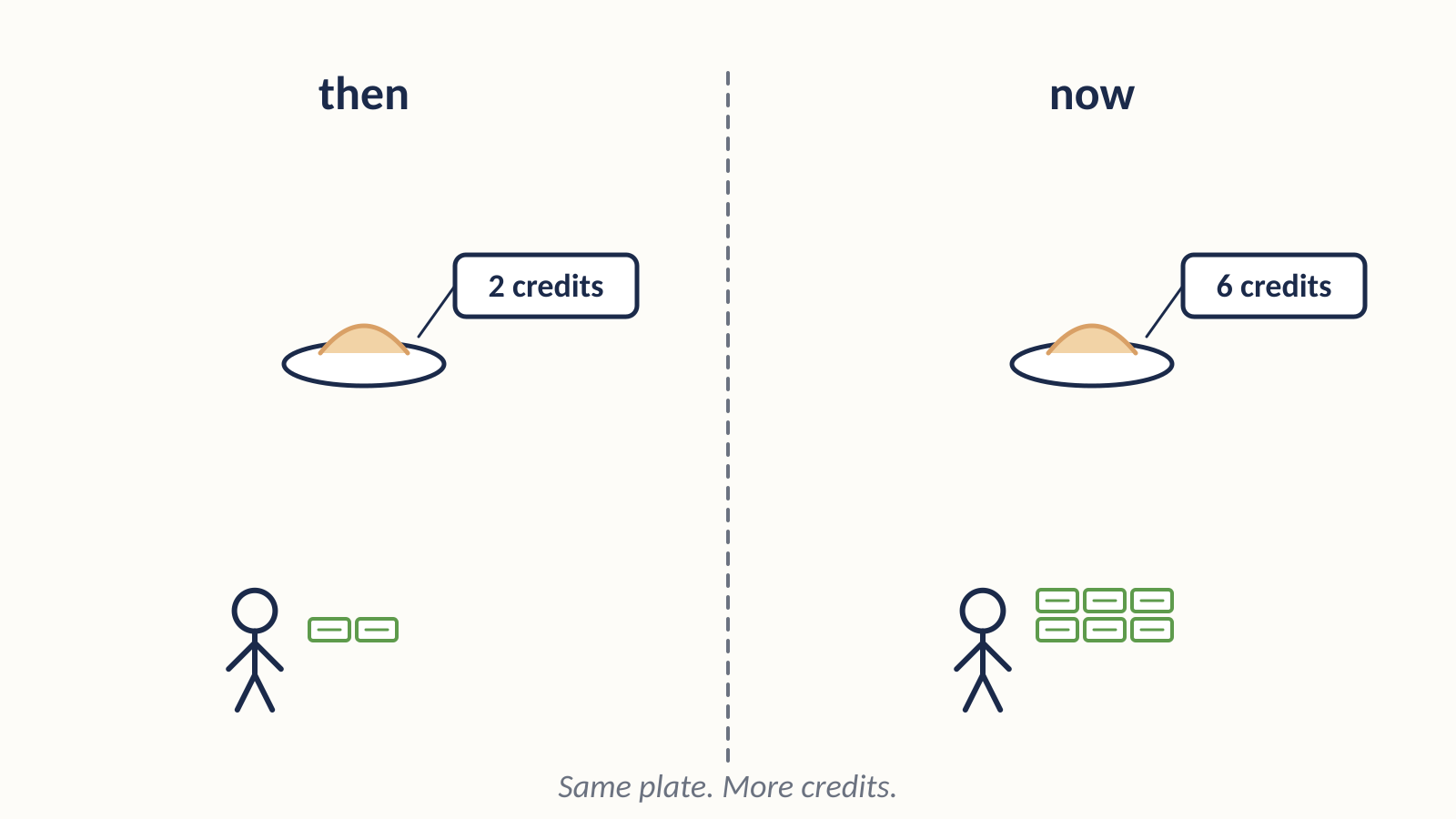
Sketch 7. Same plate, more credits.
The people who pay first are the ones who saved. If your grandmother put away enough credits to buy a cabin, those same credits might now buy a deck chair for the weekend. She didn't do anything wrong. She did exactly what she was told to do, which was work and save, and the saw took the difference.
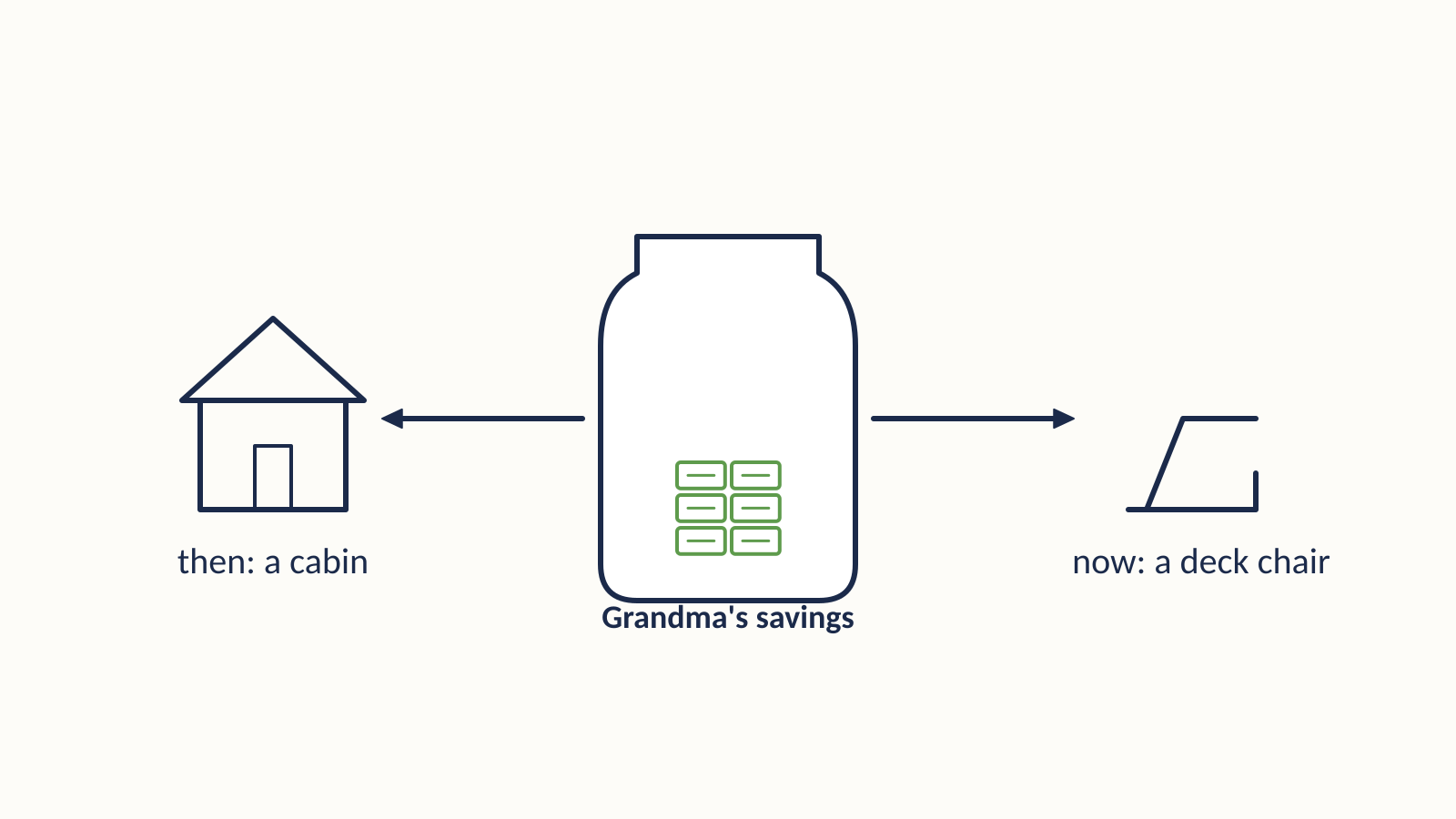
Sketch 8. Grandma's savings, then and now.
The strange part is how little anyone notices. The Purser rarely takes many planks at once. He takes a few a year, the ship rides a little lower in the water, and everyone adjusts. Wages creep up a bit, prices creep up a bit more, and the waterline creeps up the hull while everyone on deck keeps smiling.
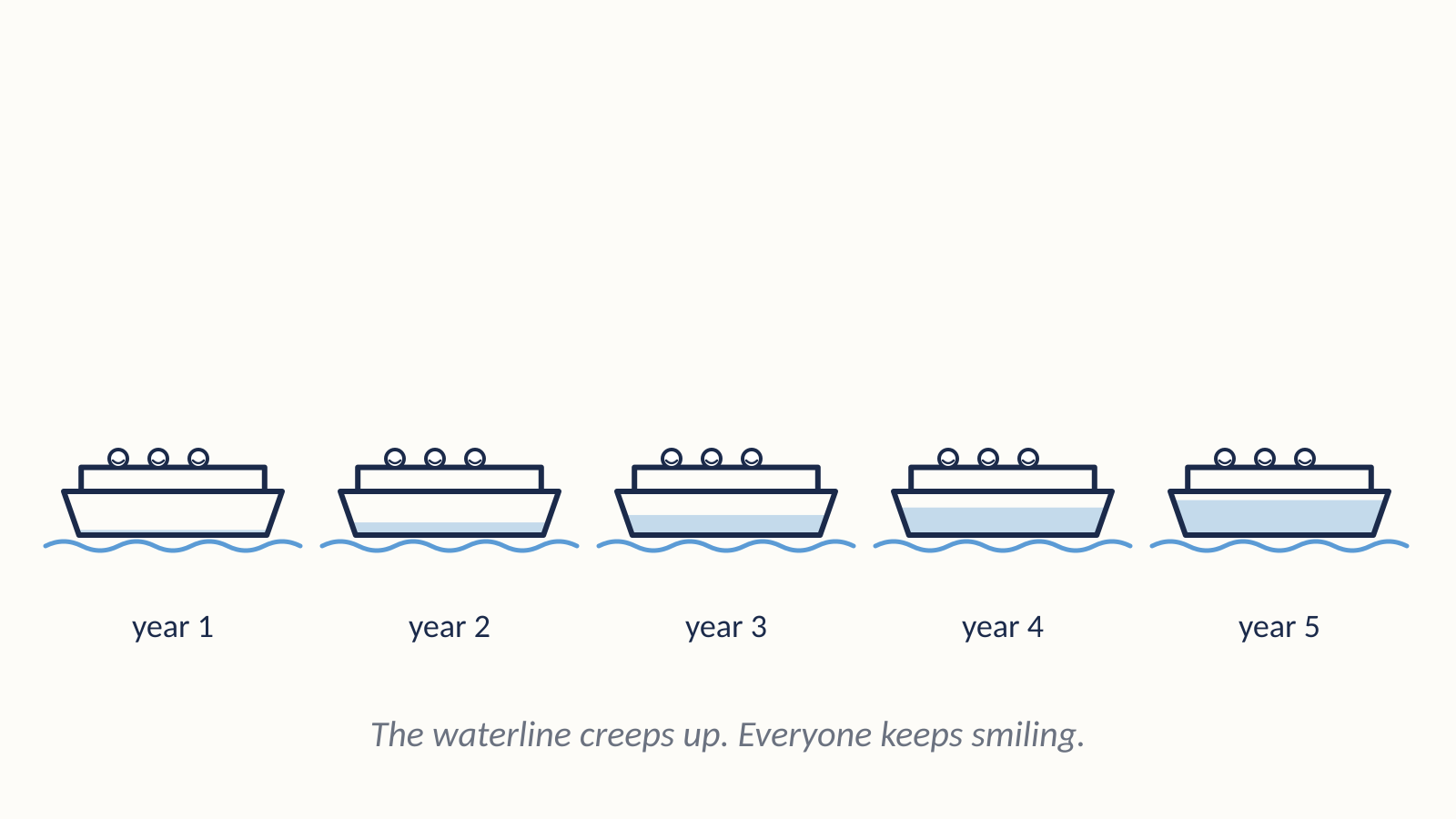
Sketch 9. The slow leak.
You might be thinking that a little inflation is supposed to be healthy. That's the official plan, and there's a real argument for it: a little inflation nudges people to spend and invest instead of hoarding, and it gives the Purser room to steer. But the plan depends on the Purser keeping the saw small, forever, through every crisis. That's a lot to ask of one office with one saw, and history isn't kind to that bet.
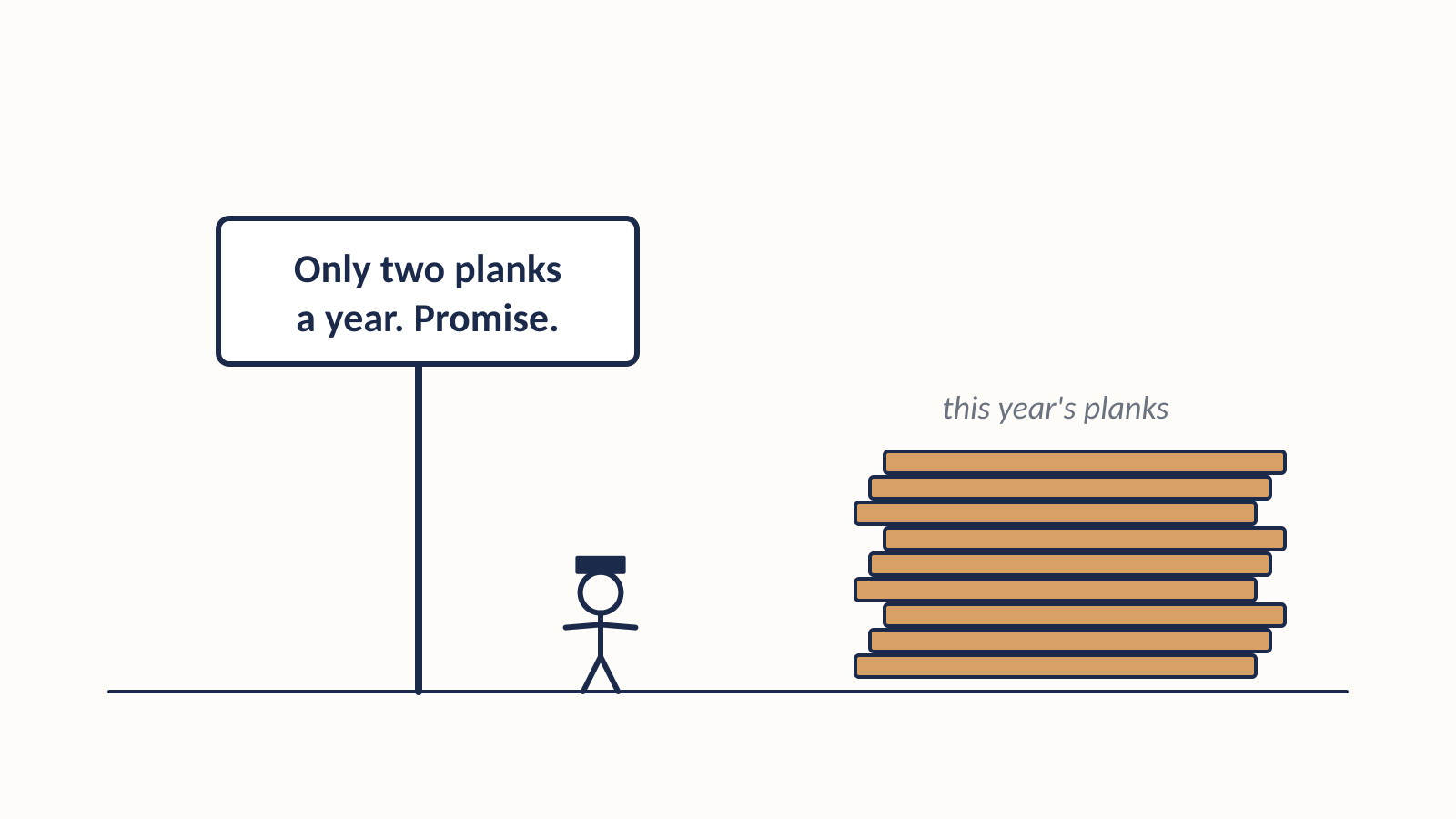
Sketch 10. The two-plank promise.
And this has happened before
The cruise ship isn't the first money ship, and it won't be the last. There's a whole graveyard of them on the sea floor.
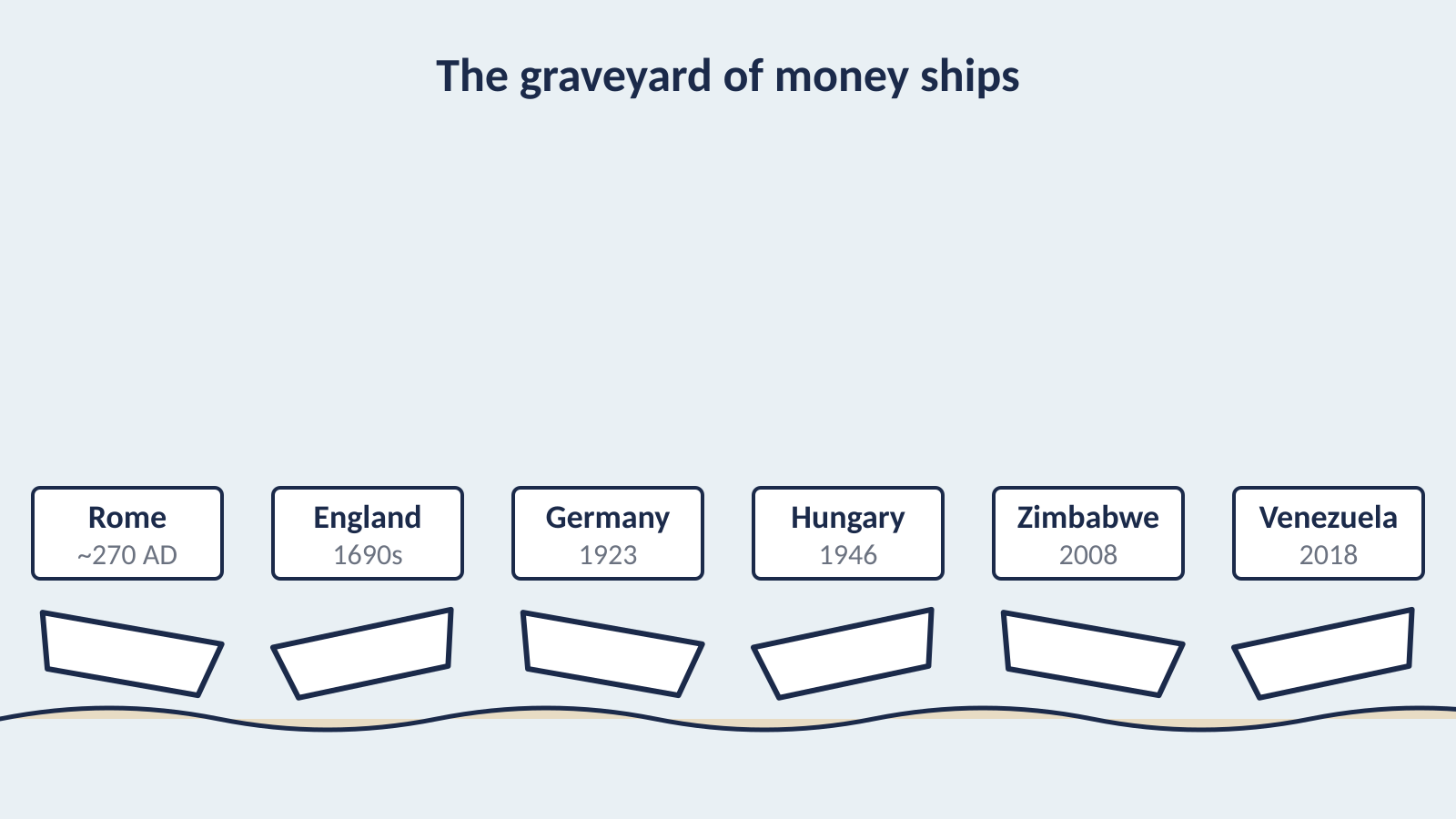
Sketch 11. The graveyard of money ships.
Rome kept cutting the silver in its coins until a silver coin was mostly not silver. In England in the 1690s, people clipped silver off the edges of coins until the currency was so damaged the government had to recall it and mint new coins. Germany printed so much money in 1923 that people carried it in wheelbarrows. Hungary in 1946 had the fastest price collapse on record, with prices doubling in less than a day. Zimbabwe printed its way to collapse by 2008, and Venezuela followed a decade later.
Each of those was a ship where the Purser's saw got out of hand. The details are different every time, but the pattern holds. The leak starts slowly, people adjust, and then one day the leak is fast enough that everyone notices at once.
When that happened, people jumped to whatever held. Romans moved toward gold coins. The English got new coins that were harder to clip. Germans got a new mark. Zimbabweans and Venezuelans moved to US dollars. Most of the time they climbed onto another ship, and most of the time that ship had a Purser too.
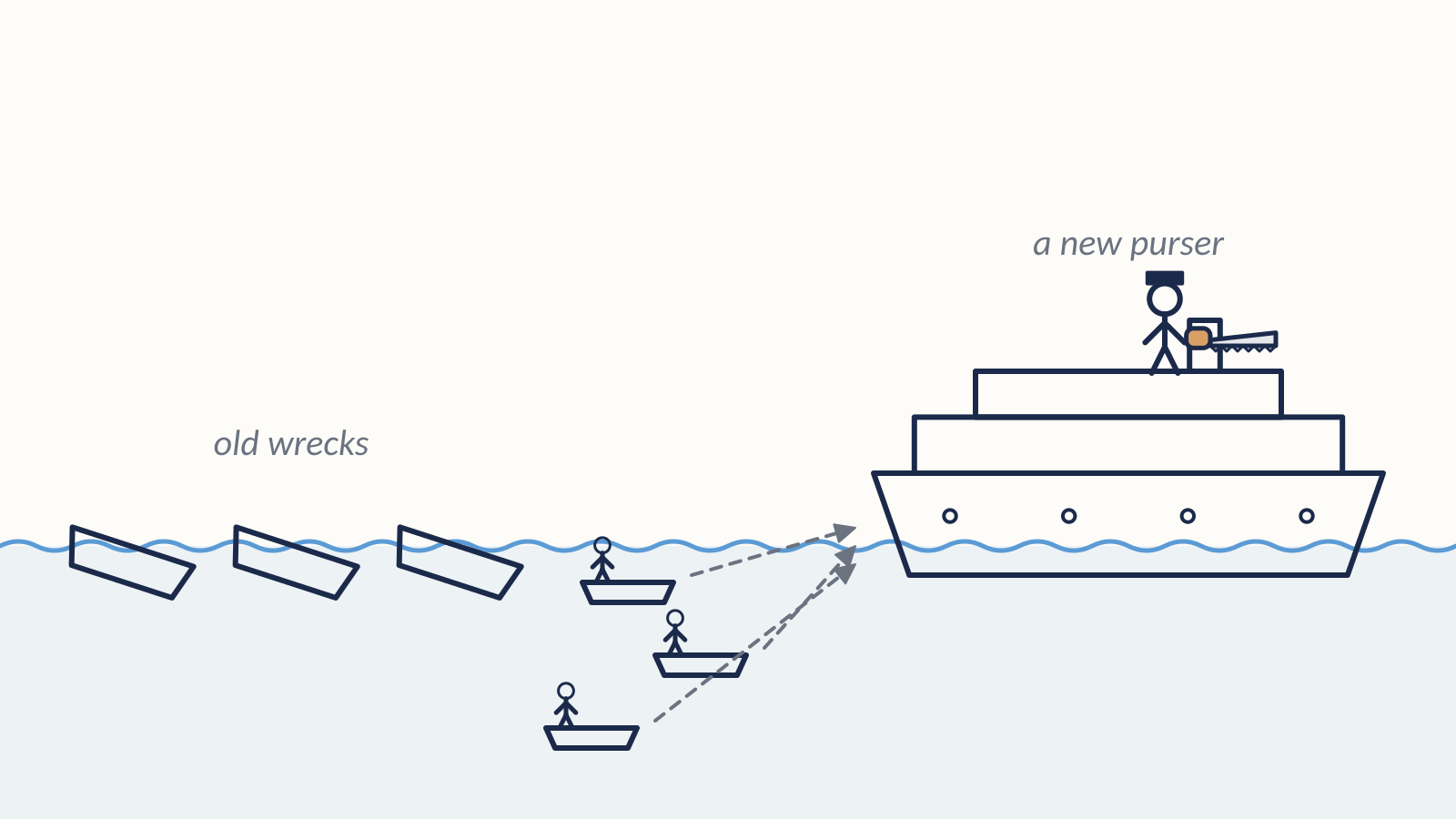
Sketch 12. People rowed to whatever held, usually another ship with a Purser.
Zimbabwe is the one I keep coming back to. In 2009 the country effectively abandoned its own currency, and people climbed aboard the biggest, sturdiest ship nearby, the US dollar. That worked, because there was a bigger ship to climb onto.
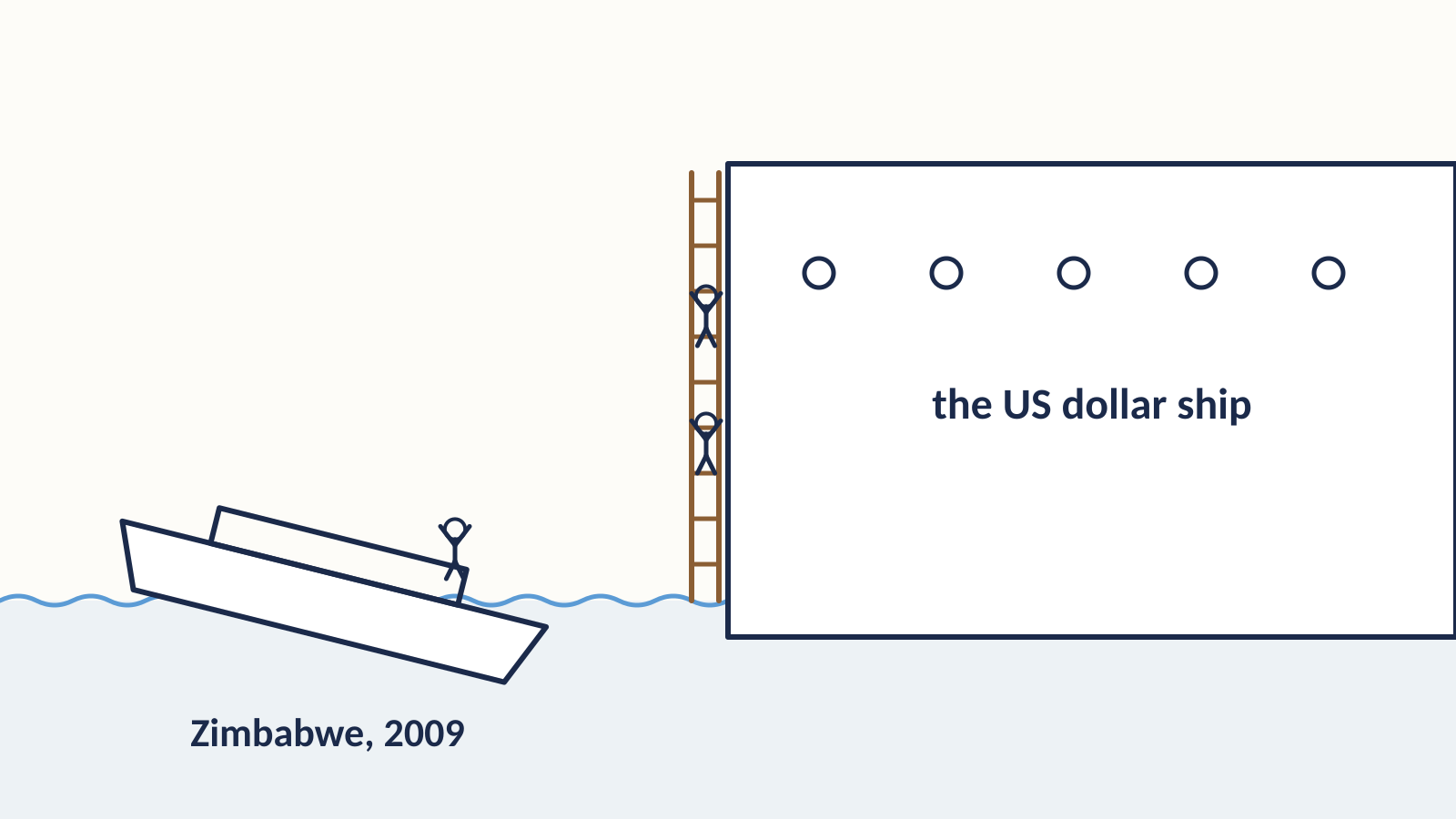
Sketch 13. Zimbabwe climbs aboard the dollar.
Now ask the obvious question. If the biggest ship in the world starts leaking faster, where do its passengers go? There is no bigger ship behind it.
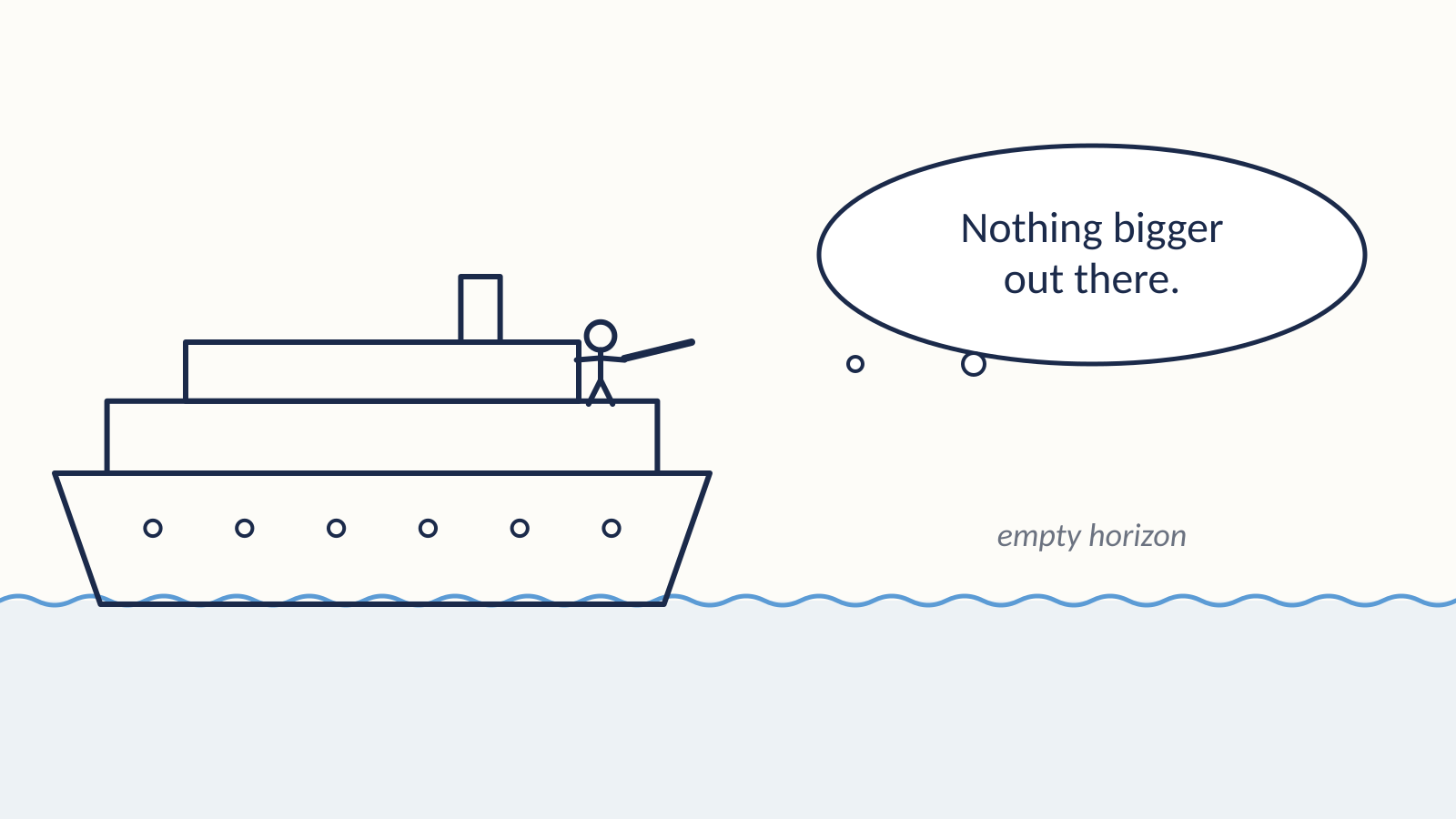
Sketch 14. No bigger ship.
I want to be careful here, because this is where arguments like this usually go off the rails. The US is not Zimbabwe. It's a far bigger ship with a far bigger economy, and its Purser saws far more slowly. My point isn't that the dollar is about to collapse. My point is that it's the same kind of ship, built the same way, and the difference between it and the wrecks is speed, not kind.
And the geeks saw it first
On every ship, the first people to notice a problem with the hull are the ones down in the engine room. They watch the gauges, and they see the water before it reaches the passenger decks.
In money, the engine room was full of programmers, cryptographers and people who read central bank reports for fun. When I got into Bitcoin in 2013, that's where I was, and the gauge everyone kept staring at might as well have been labeled "planks left."
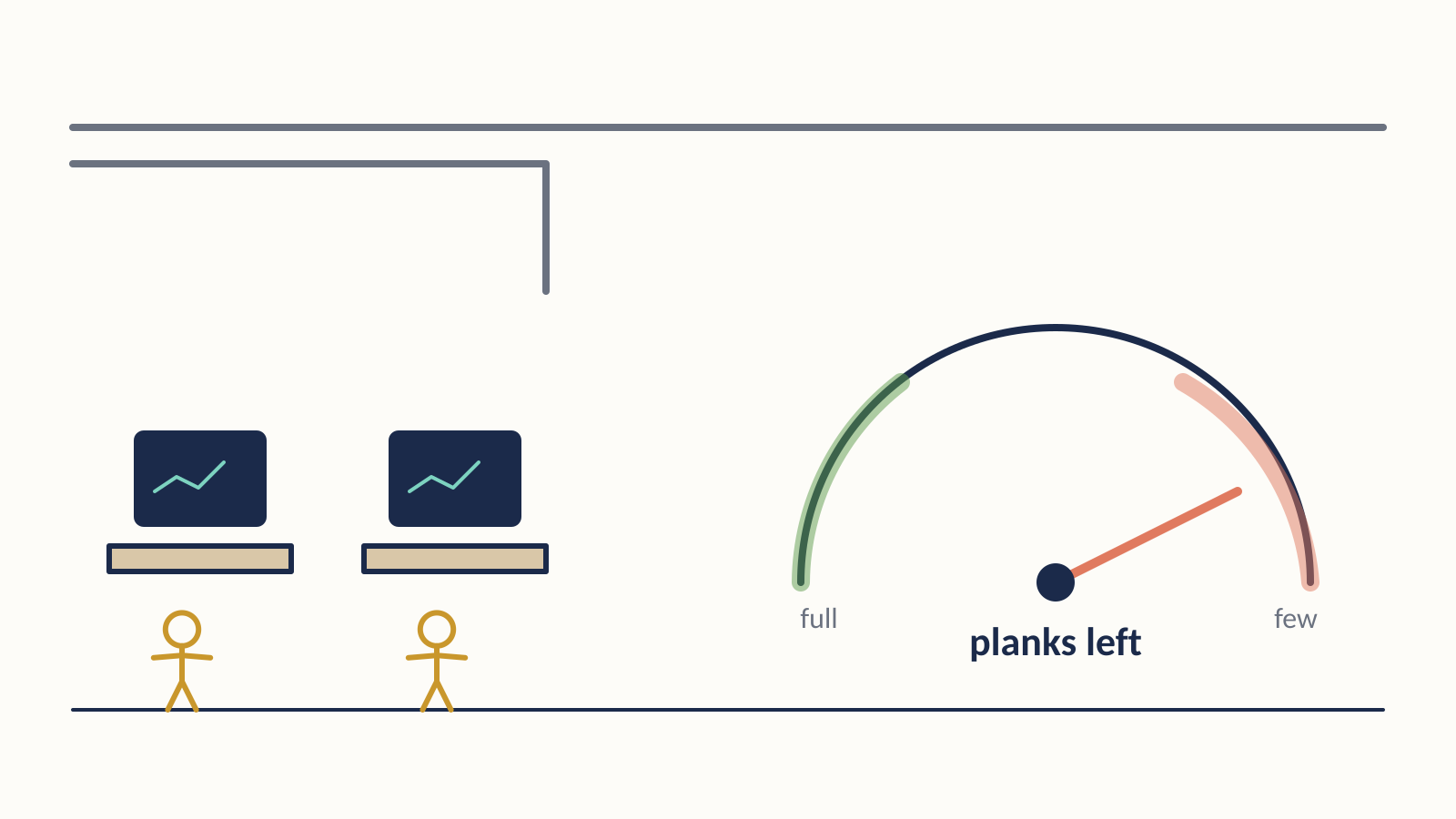
Sketch 15. The engine room saw it first.
So the geeks did something remarkable. They built their own boat. It had no Purser, and it had a fixed number of tokens that nobody could ever add to, so there was no saw. The rules were written in code anyone could read, and they were enforced by thousands of computers instead of one office.
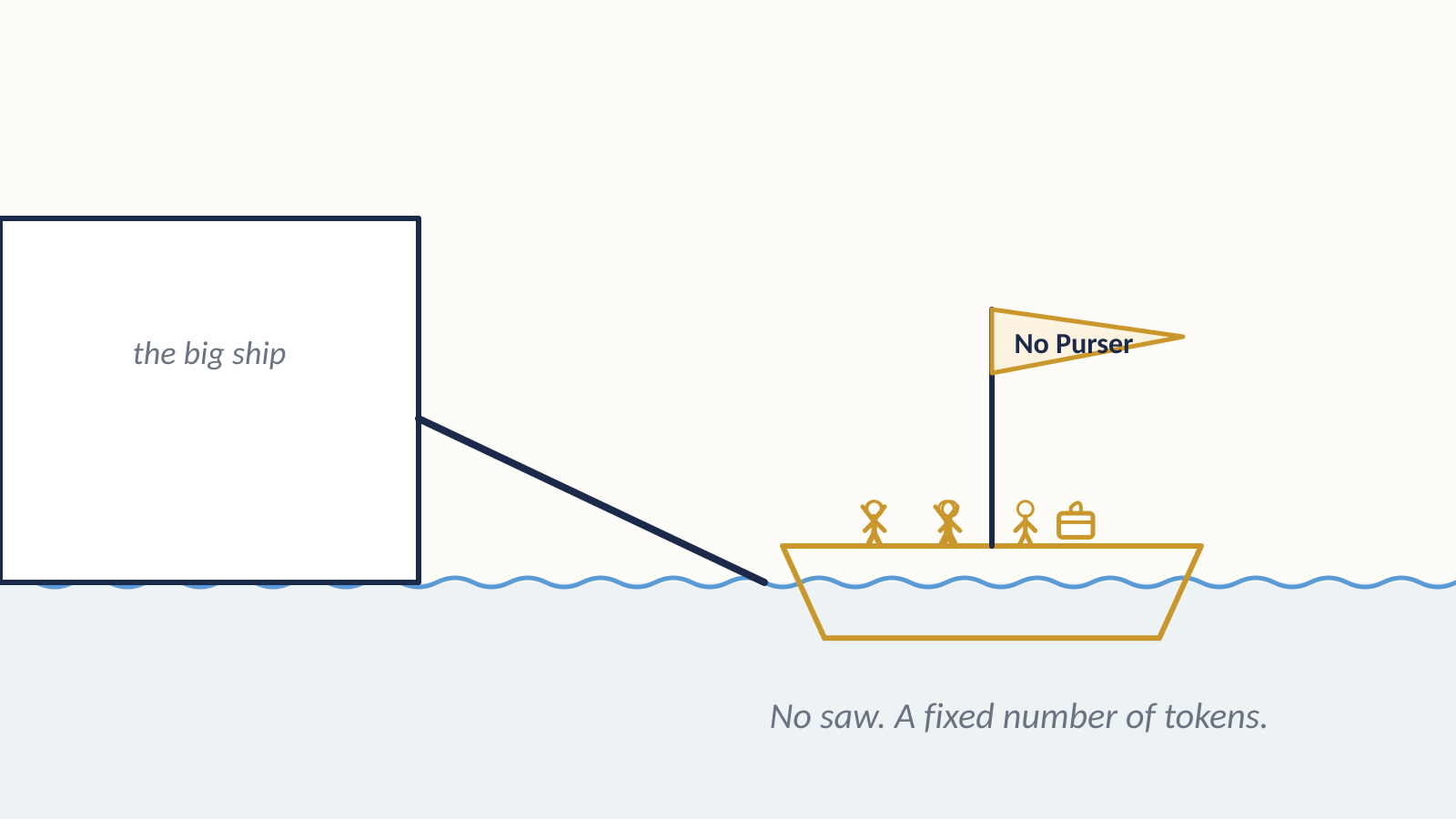
Sketch 16. Launch day for the geek boat.
I want to give them full credit, because they deserve it. Bitcoin proved that money without a Purser can work. Before it launched, most serious people would have told you that was impossible. That proof is the foundation everything since has been built on, including what I'm going to describe later.
But the boat hit two walls.
The first wall is the people who boarded first. When the boat launched, tokens were nearly free, and the early passengers collected a lot of them. By the time your aunt hears about it over dinner, the seats near the front are already piled high with someone else's tokens. Joining feels less like boarding a new ship and more like buying into someone else's windfall. Most people's gut tells them something is off about that, and their gut isn't wrong.
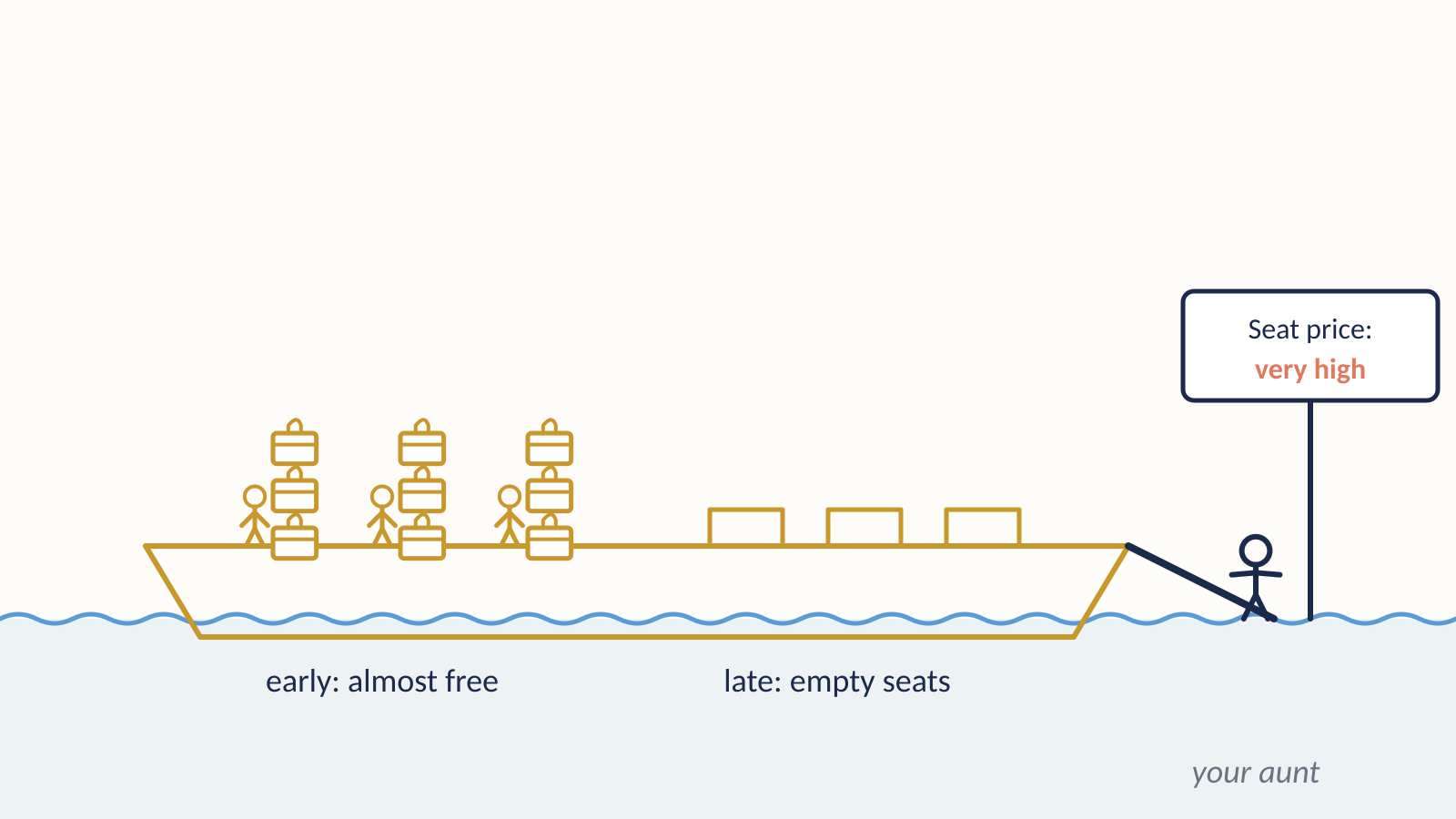
Sketch 17. Seats by boarding date.
The second wall is that the tokens keep getting more valuable. That sounds like a feature, and for the people holding them it is. In 2010 a programmer famously paid 10,000 bitcoin for two pizzas. Years later those coins were worth hundreds of millions of dollars, and everyone on the boat learned the same lesson: never spend your tokens.
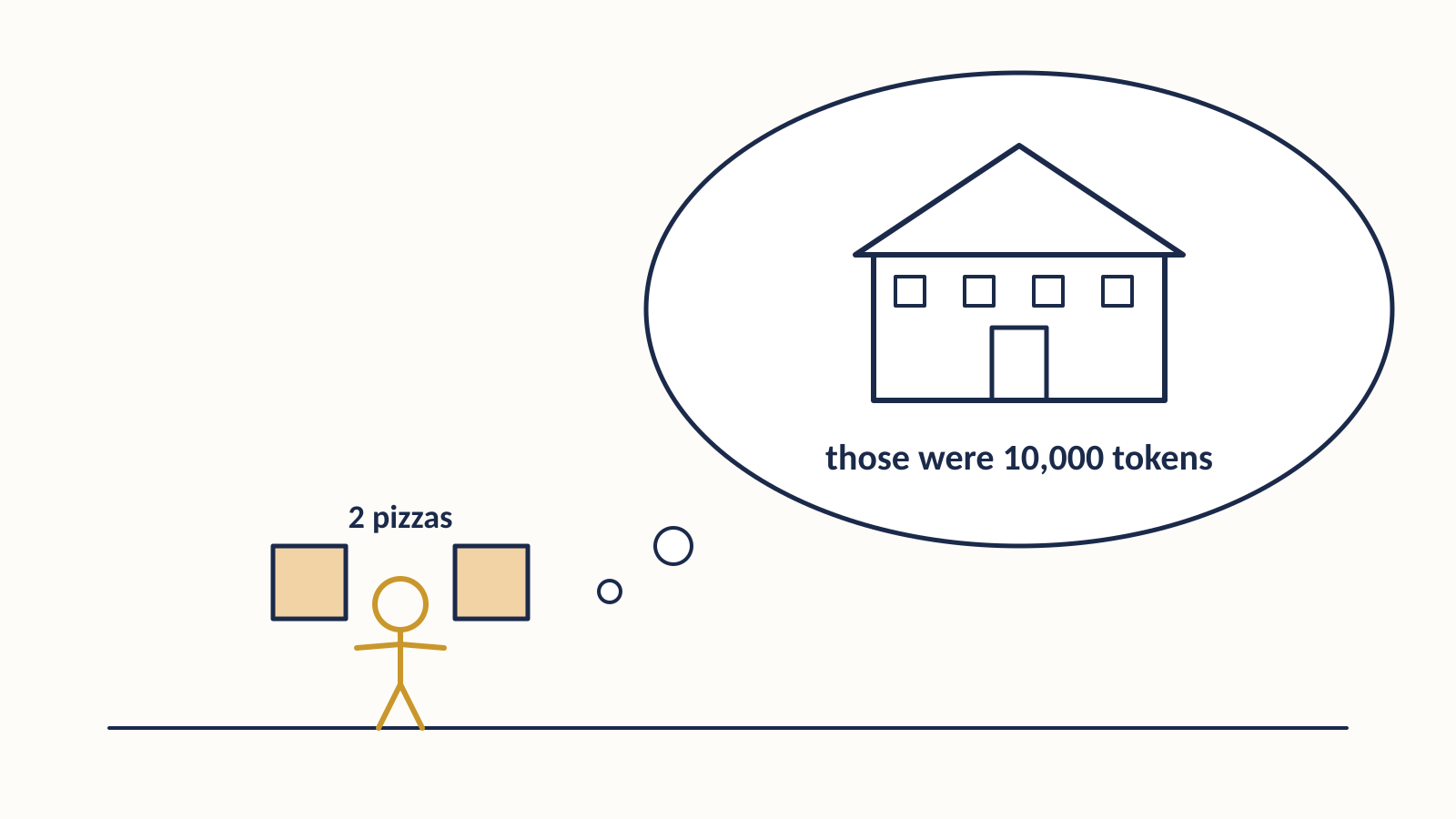
Sketch 18. The pizza.
So almost nobody does. If the thing in your pocket will buy more next year, you hold it. Everyone hugs their chest, and the shops on deck sit empty, because nobody wants to be the one who traded a future mansion for a sandwich.
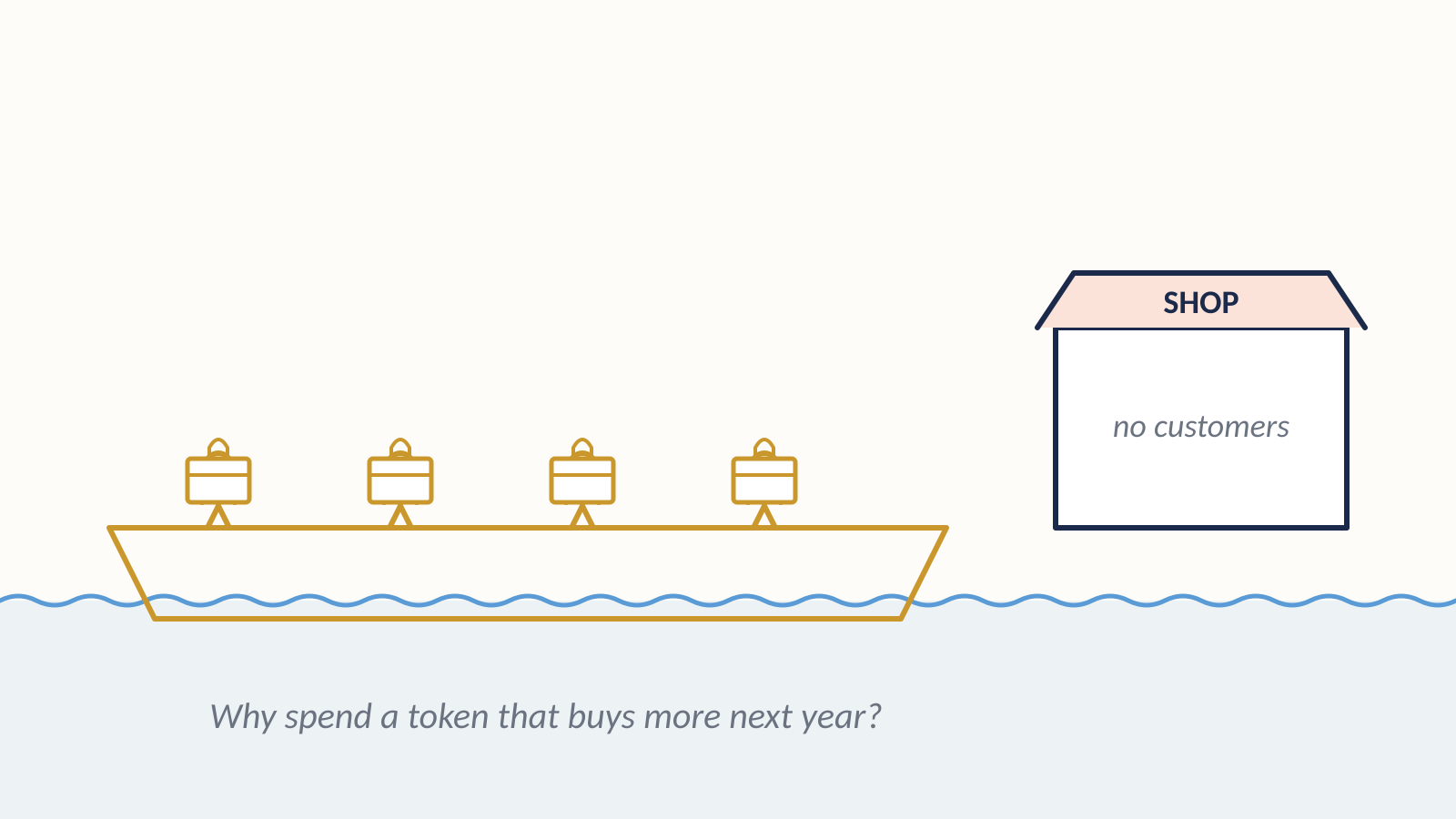
Sketch 19. Nobody spends.
That leads to the tell. The Bitcoin boat has no kitchen. When the geeks get hungry, they row back to the big ship, trade some tokens for credits, and buy groceries at the same buffet as everyone else. Even the people who escaped still measure their success in the old ship's credits, waiting for the number to go up so they can trade back.
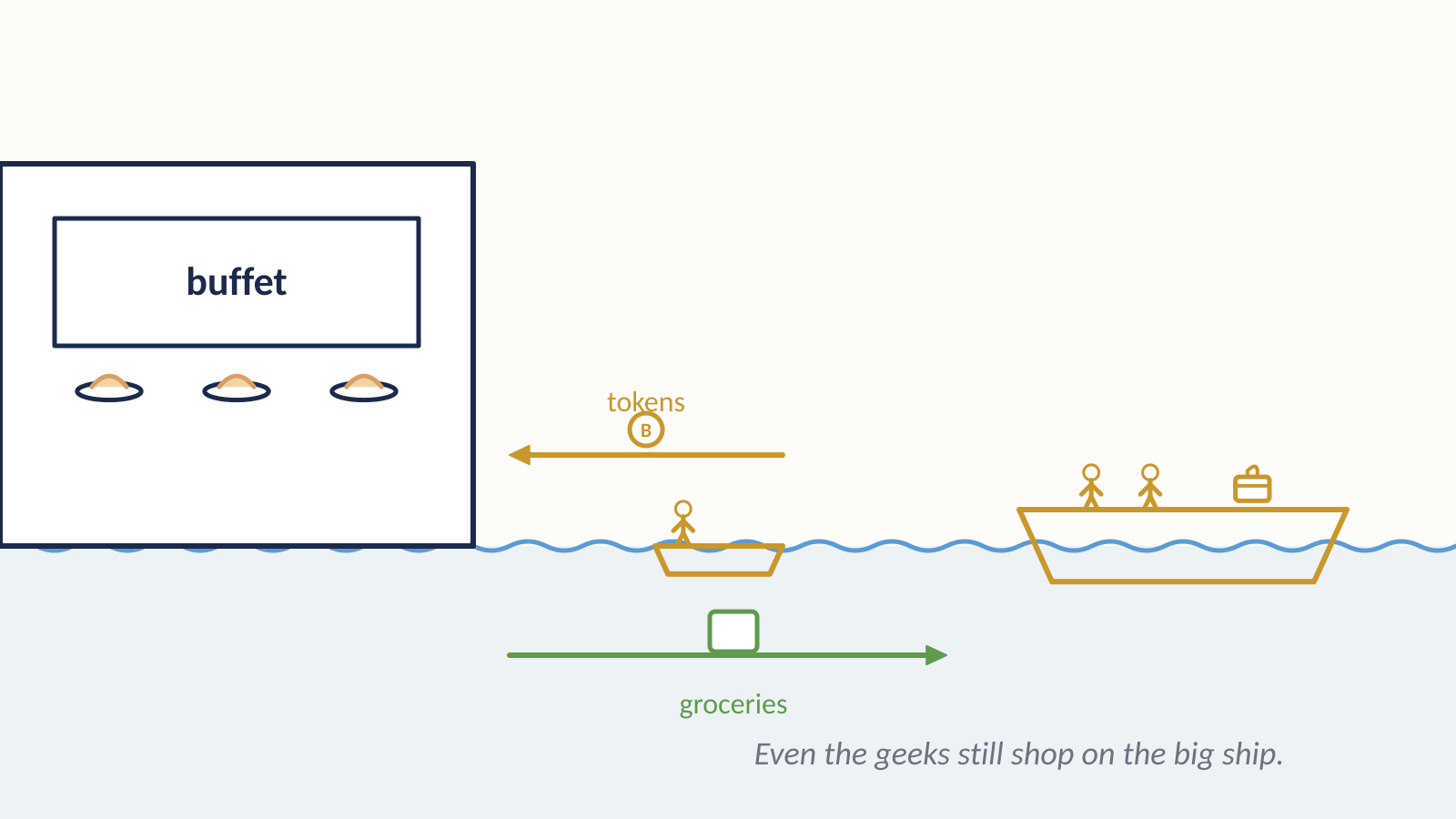
Sketch 20. The grocery run.
So here's what I'd say to the people on that boat, as someone who has been down in that engine room with them: you were right about the leak. The boat just can't carry everyone.
And most people don't care, yet
If the big ship leaks and the geek boat can't carry everyone, you'd expect a panic. There isn't one, and there's a good reason for that.
The big ship is enormous. It has the shops, the jobs and the buffet. Your paycheck is in its credits, your rent is in its credits, and your grocery bill is in its credits. Everyone still needs it, including the geeks, and including me. Next to it, the Bitcoin boat looks like a dinghy.
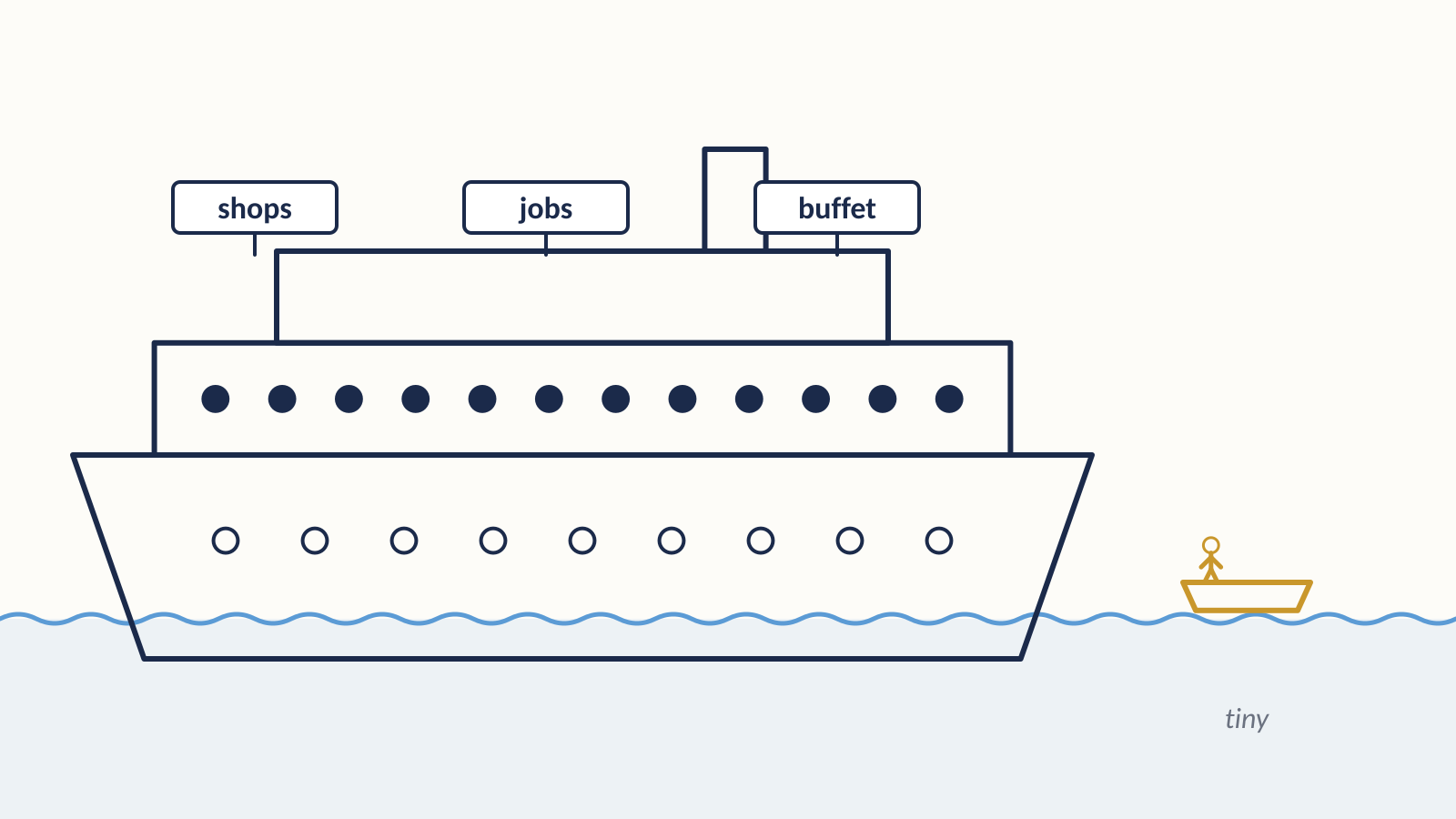
Sketch 21. The big ship still has the food.
The leak is real, but it's slow. Prices rise a little each year, wages mostly follow, and the pain stays below the line where people actually start to care. Below that line, people grumble about the price of groceries and then go back to their lives. Nobody jumps off a ship that's still serving dinner.
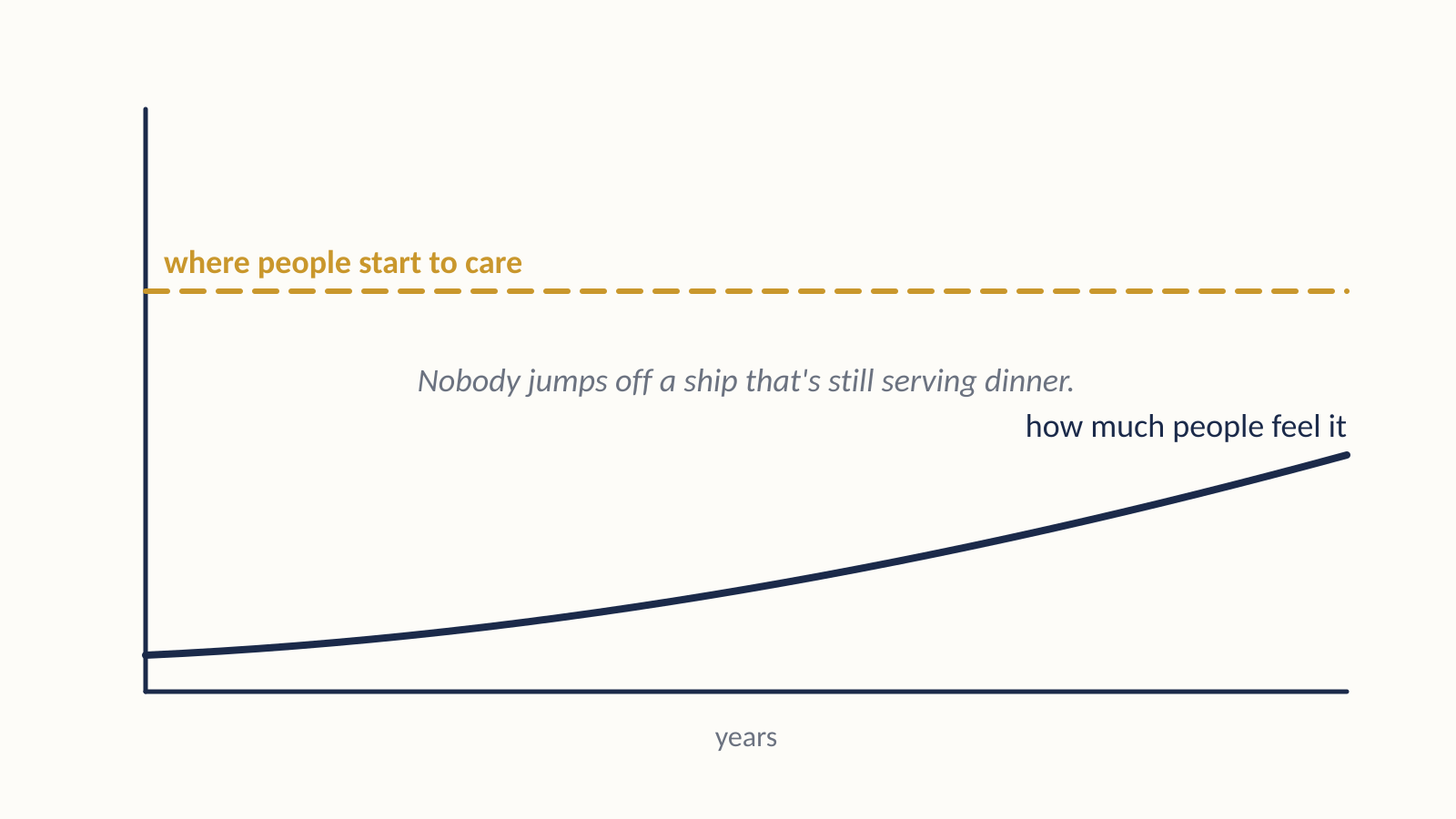
Sketch 22. The caring line.
It helps to think about who cares, and when, as a crowd. A few people care very early, and those are the geeks. A few more care next, and those are the builders, the people who want to build something better before they need it. Then there's the big majority, who will care when it becomes impossible not to. And then there are the late ones, who will care after almost everyone else has already moved.
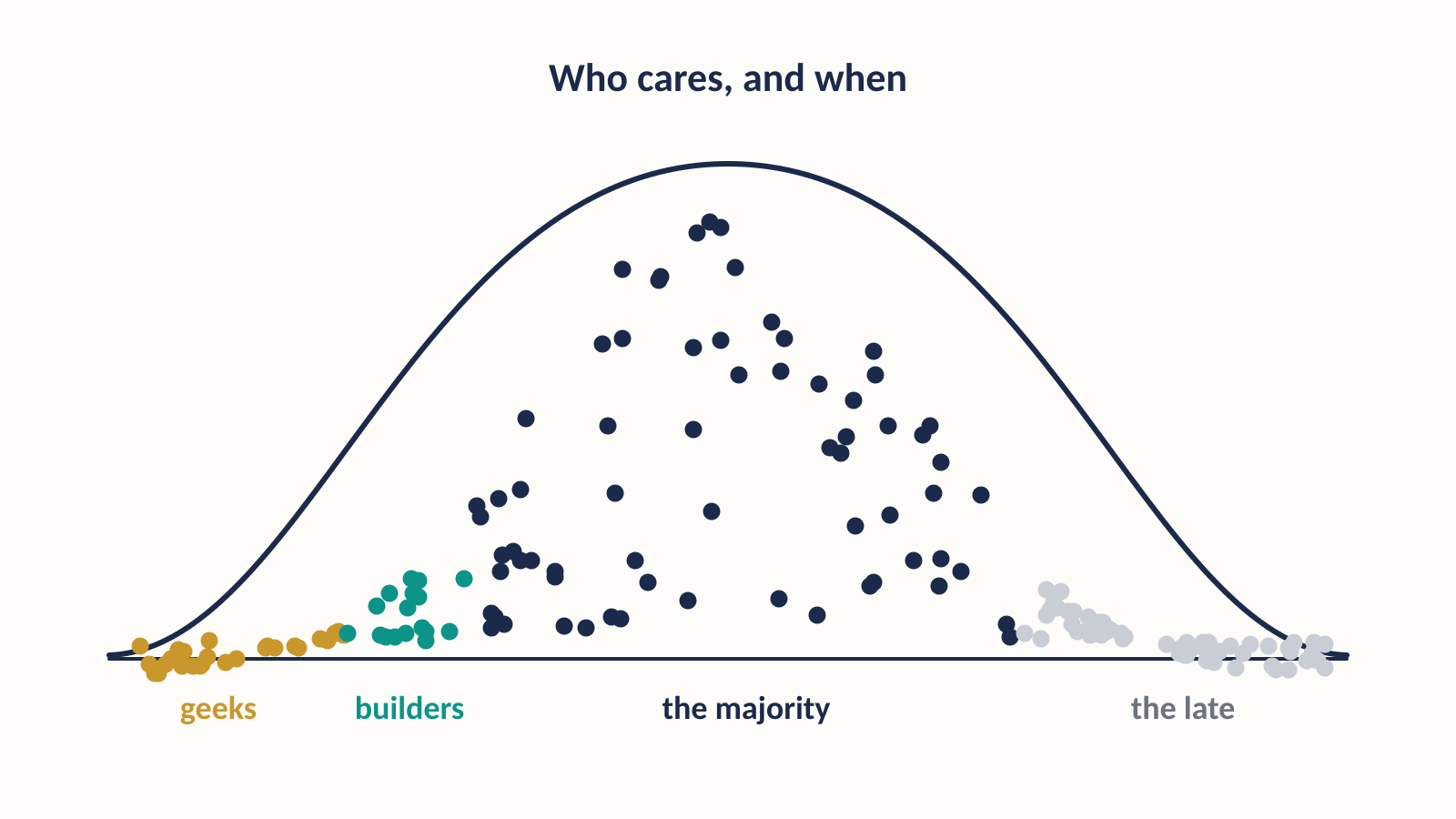
Sketch 23. Who cares, and when.
Right now we're early on that curve. Most people are still in the big hump in the middle, and they aren't wrong to stay put. The real question is what moves them.
But the robots are coming aboard
Here's what changes everything. Robots are starting to do the jobs aboard the ship.
They clear tables, they cook in the galley, and they run the engine room. They don't get tired, they don't need cabins, and they work for almost nothing. Software is doing the same thing to office work, quietly and quickly. In one sense this is wonderful news, because the ship can now produce more food, more cabins and more of everything than it ever has.
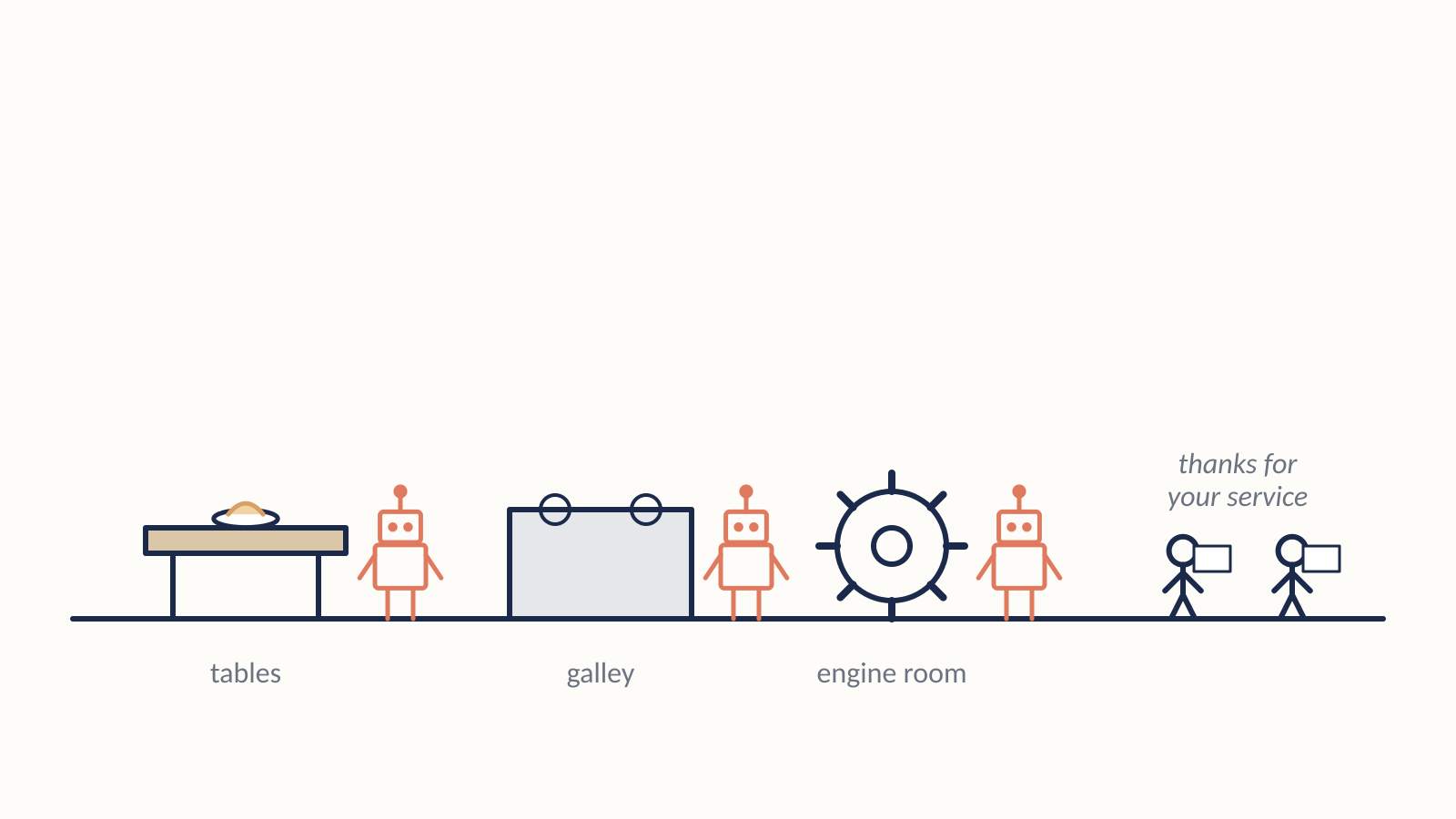
Sketch 24. Robots on every deck.
The catch is what happens to the crew. On the old ship, you earned credits by working your shift. If a robot does your shift, you don't earn those credits, and they flow instead to whoever owns the robot. The ship isn't poorer. The gains just go to the people who already own the most, while the people who used to do the work stand in a line with emptier plates.
I want to be clear about where the blame goes. It isn't the robot owners' fault, and it isn't the crew's fault either. The scoreboard was designed for a world where human work was the main way anything got made. When machines do the work, a scoreboard that only pays for work sends the gains to whoever owns the machines. That's a design flaw, not a moral one.
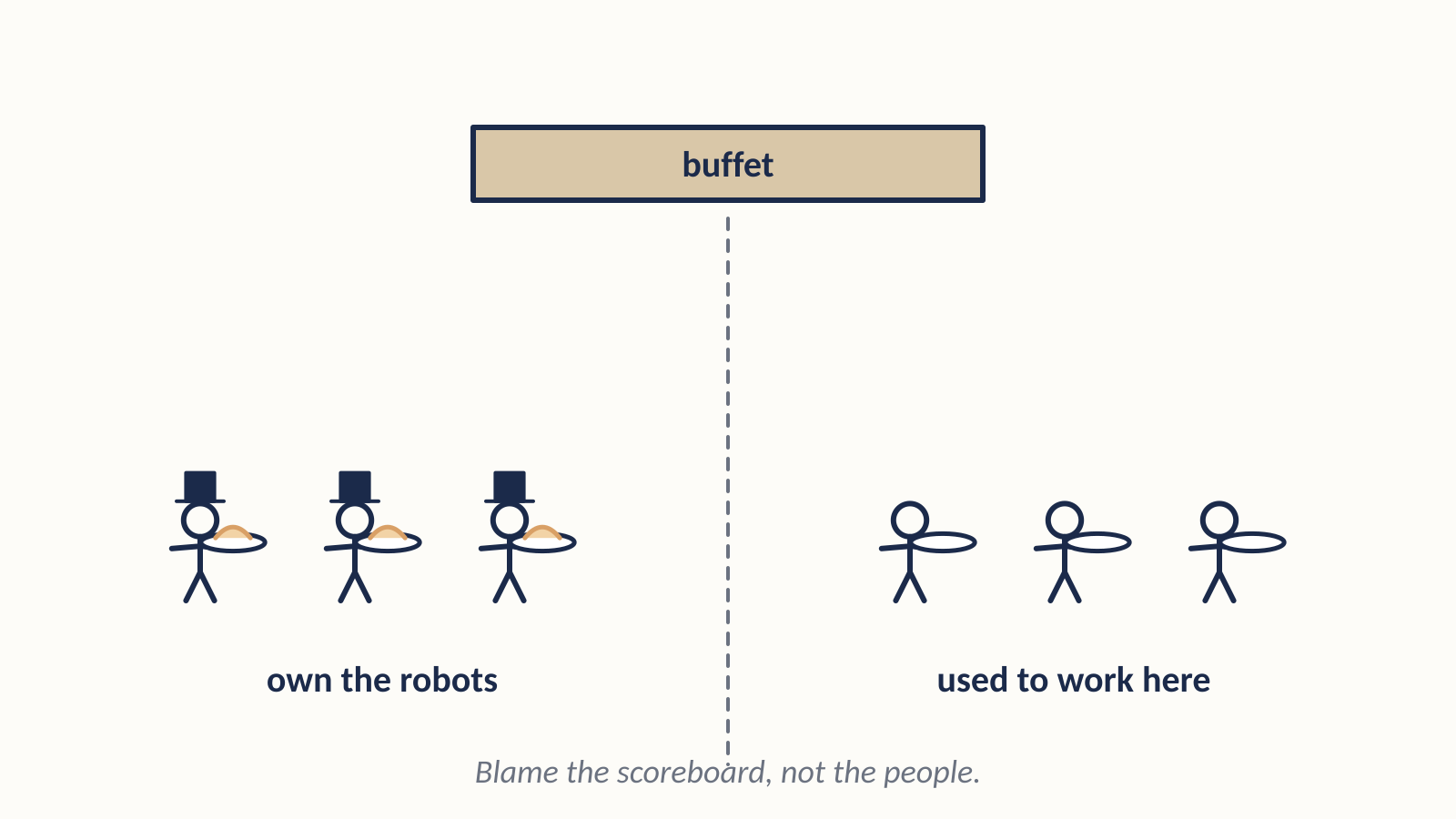
Sketch 25. Two buffet lines.
Then the Purser does what he always does when people get upset. He saws more planks to hand out more credits and keep everyone calm. We saw this exact playbook during COVID, when governments printed money to hold things together. It helped for a while, and then prices went up.
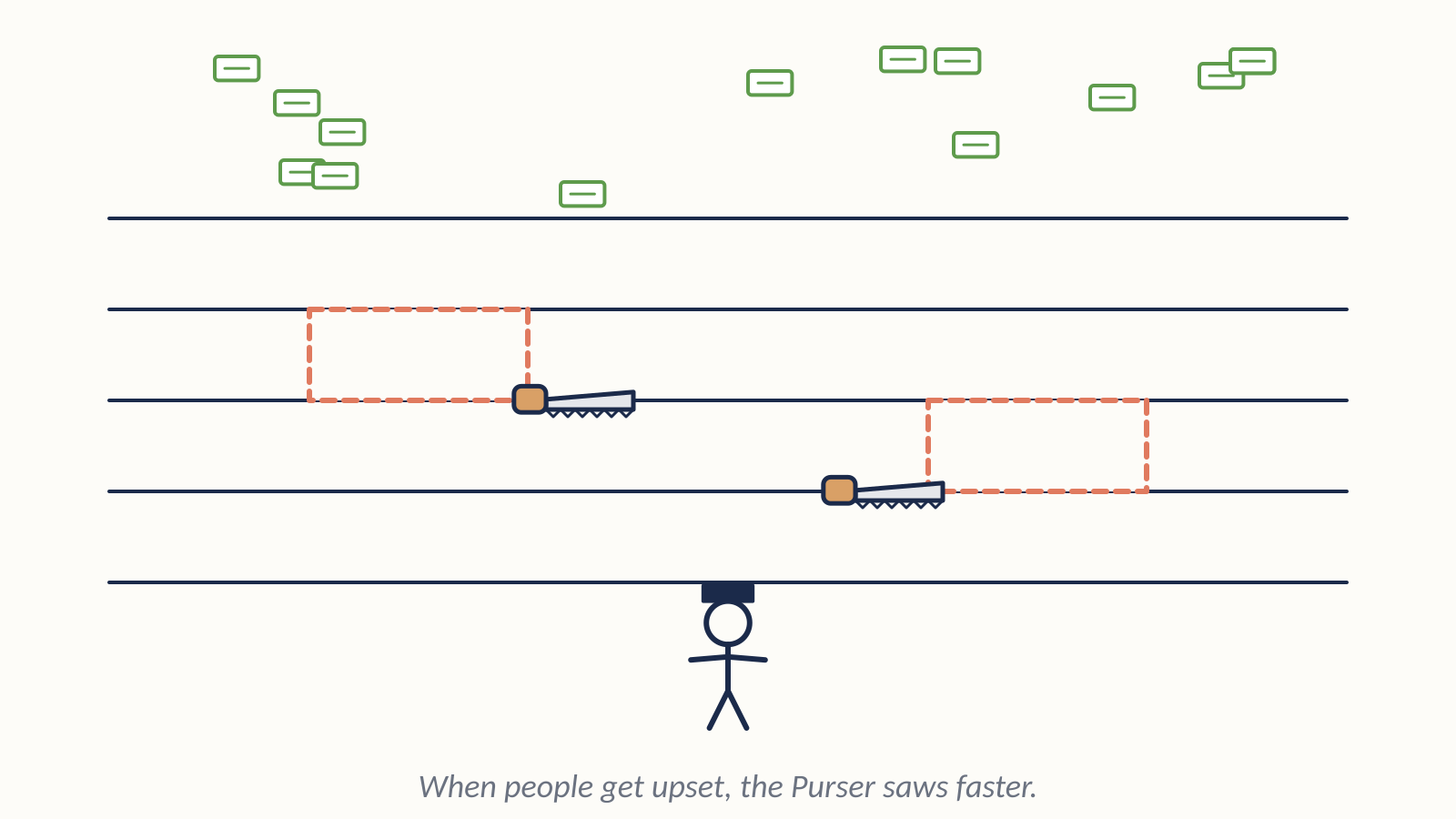
Sketch 26. The Purser saws faster.
Now put the pieces together. Robots take jobs, so people have less income. The Purser saws planks to make up the difference, so each credit buys less. When credits buy less, people need higher wages to get by, which makes robots look even cheaper by comparison, so even more work goes to robots. It's a spiral, and there's no exit from it inside the current system.
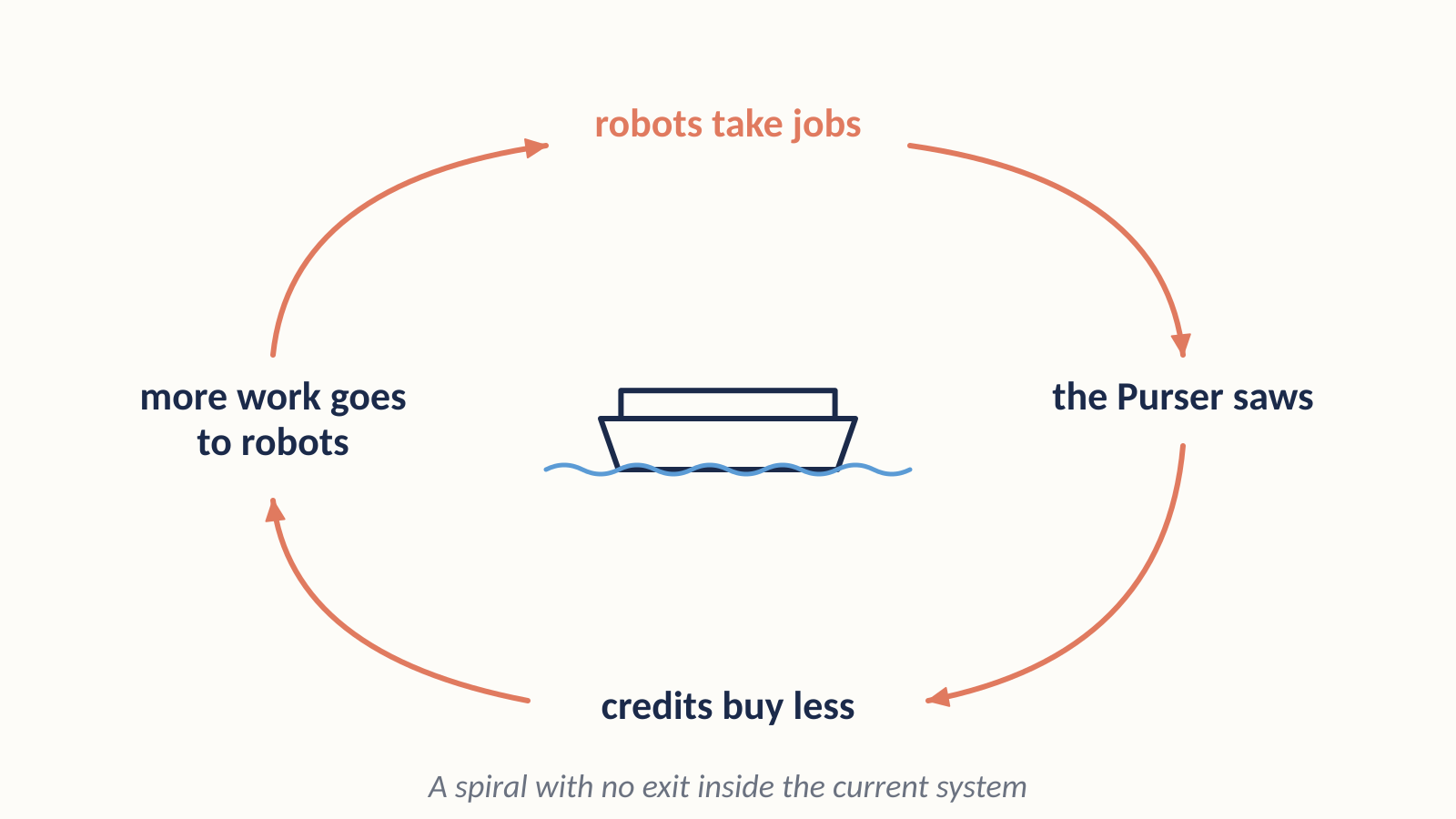
Sketch 27. The spiral.
There are two levers pushing on everyone at once. Inflation pushes the cost of living up, and robots push the chance to earn a living down. For most people, for most of history, those two lines have stayed apart, with what they could earn above what it cost to live. When the lines cross, the pain finally rises above the line where people start to care.
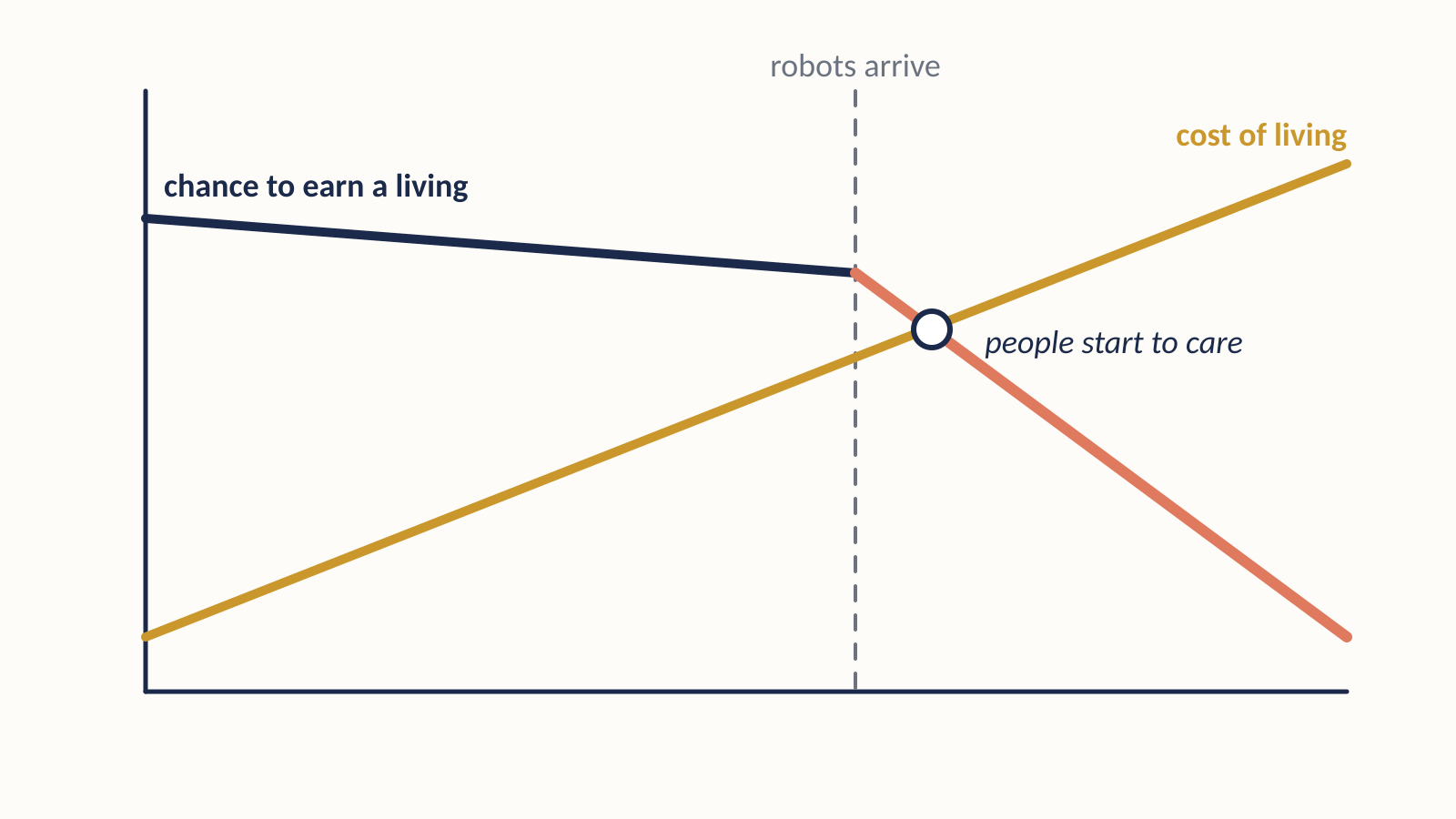
Sketch 28. The scissors.
On the crowd curve, those two levers push the "now" line toward the big hump in the middle. That's the moment the majority starts to care, and it won't be because anyone convinced them. It will be because their own paycheck and their own job did.
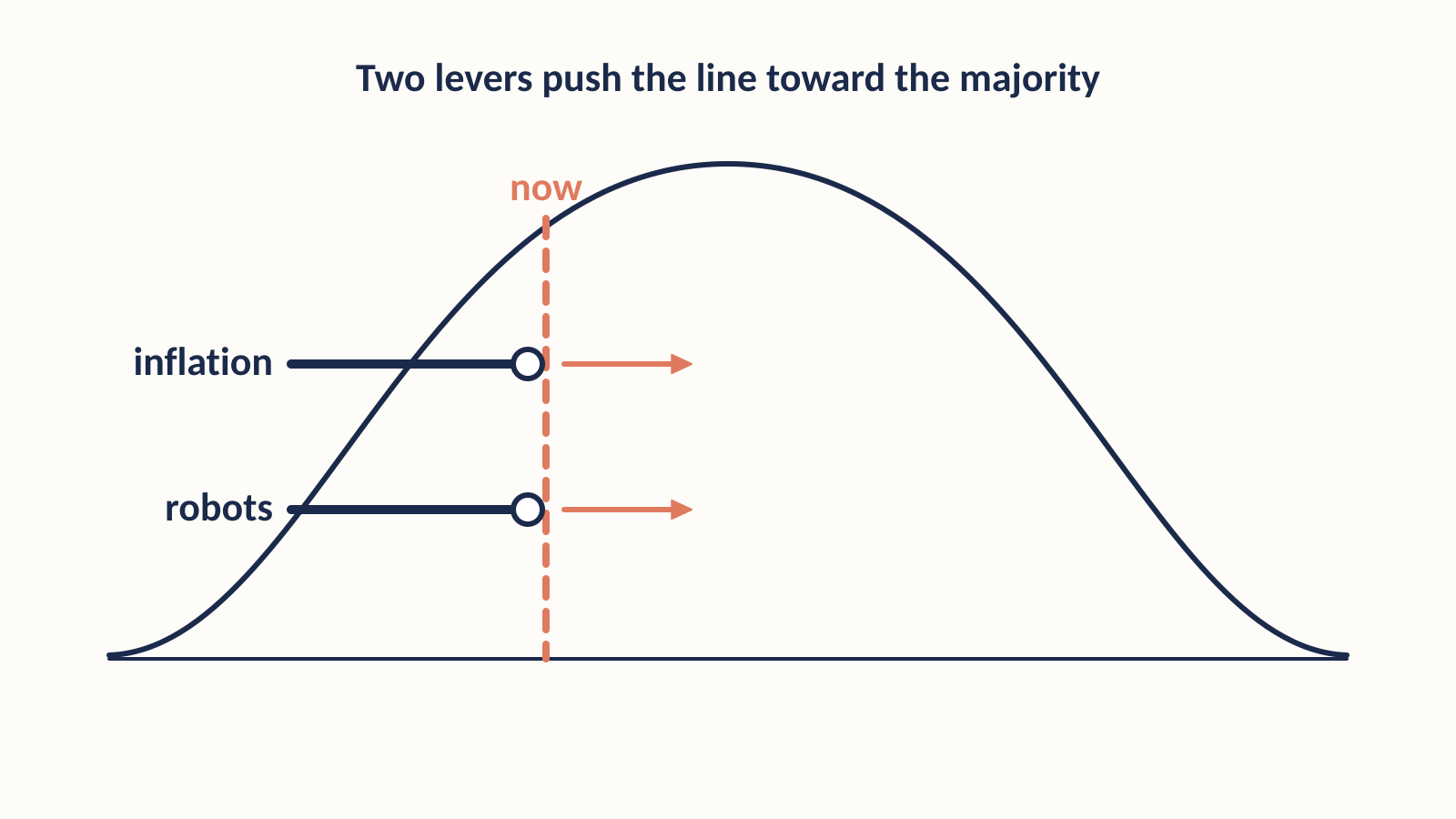
Sketch 29. Two levers push the "now" line toward the majority.
When people start caring, the question changes. It stops being "should I worry about this?" and becomes "where would I even go?" Another ship with another Purser has the same saw. The geek boat is too small, and nobody spends on it. Neither one can carry everyone.
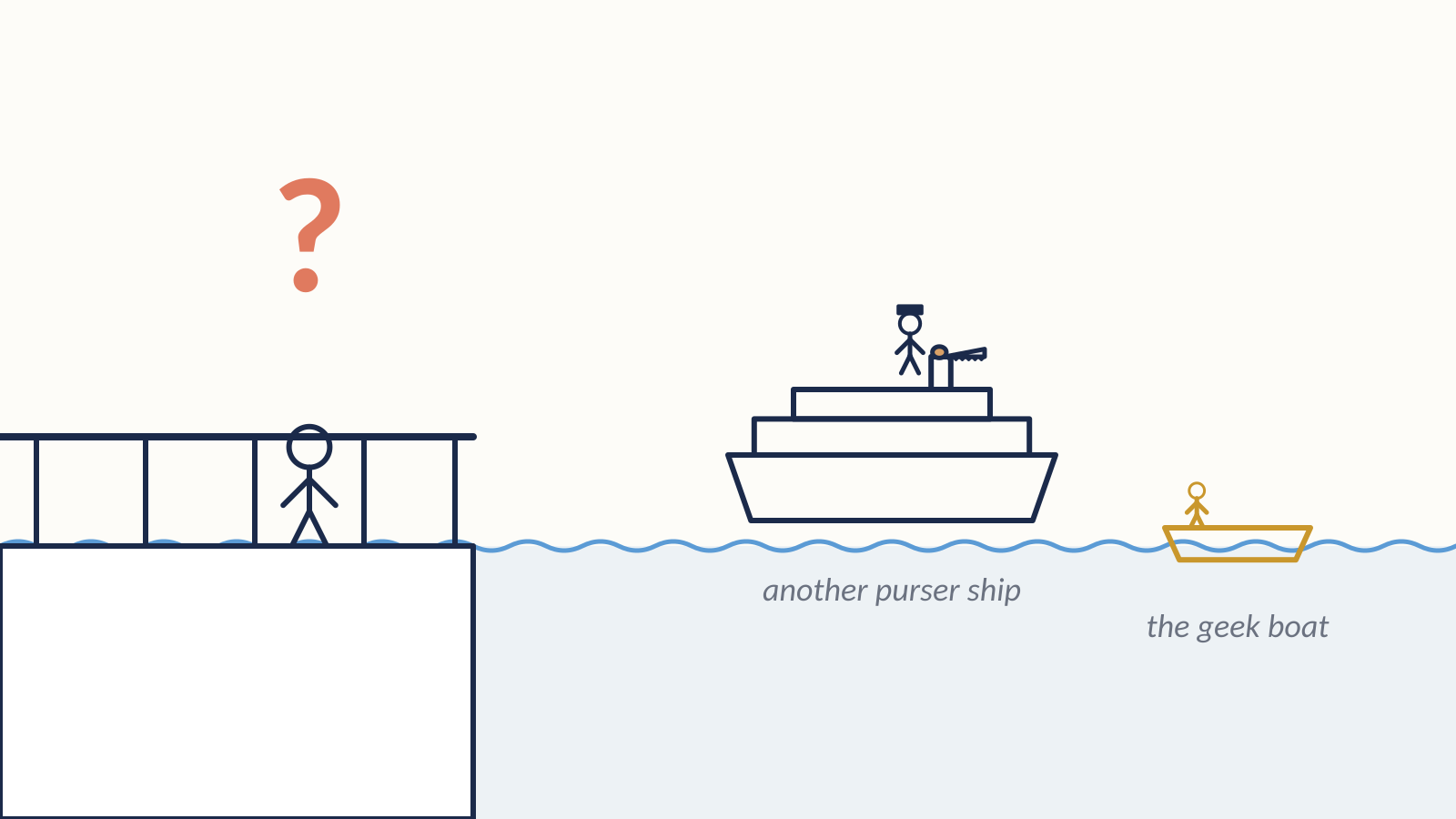
Sketch 30. Where would I even go?
Therefore: what ship would we design?
So let's do the obvious thing and design the ship we'd actually want. We don't have to guess at the requirements, because every failure we just walked through hands us one.
The Purser's saw tells us the new ship can't have a Purser. The rules have to be code that anyone can check, enforced by many independent computers rather than one office.
The first-mover wall tells us there can't be a windfall for boarding early. Someone who joins in ten years has to get the same deal as someone who joins today.
The hoarding wall tells us people have to actually spend the currency on the things they need, or shops will never open aboard.
The robots tell us the ship has to work in a world where machines do much of the work and people still need to eat.
And the long history of money ignoring certain kinds of work tells us the new ship should let all human work show up, not only the work that happens to come with a paycheck.
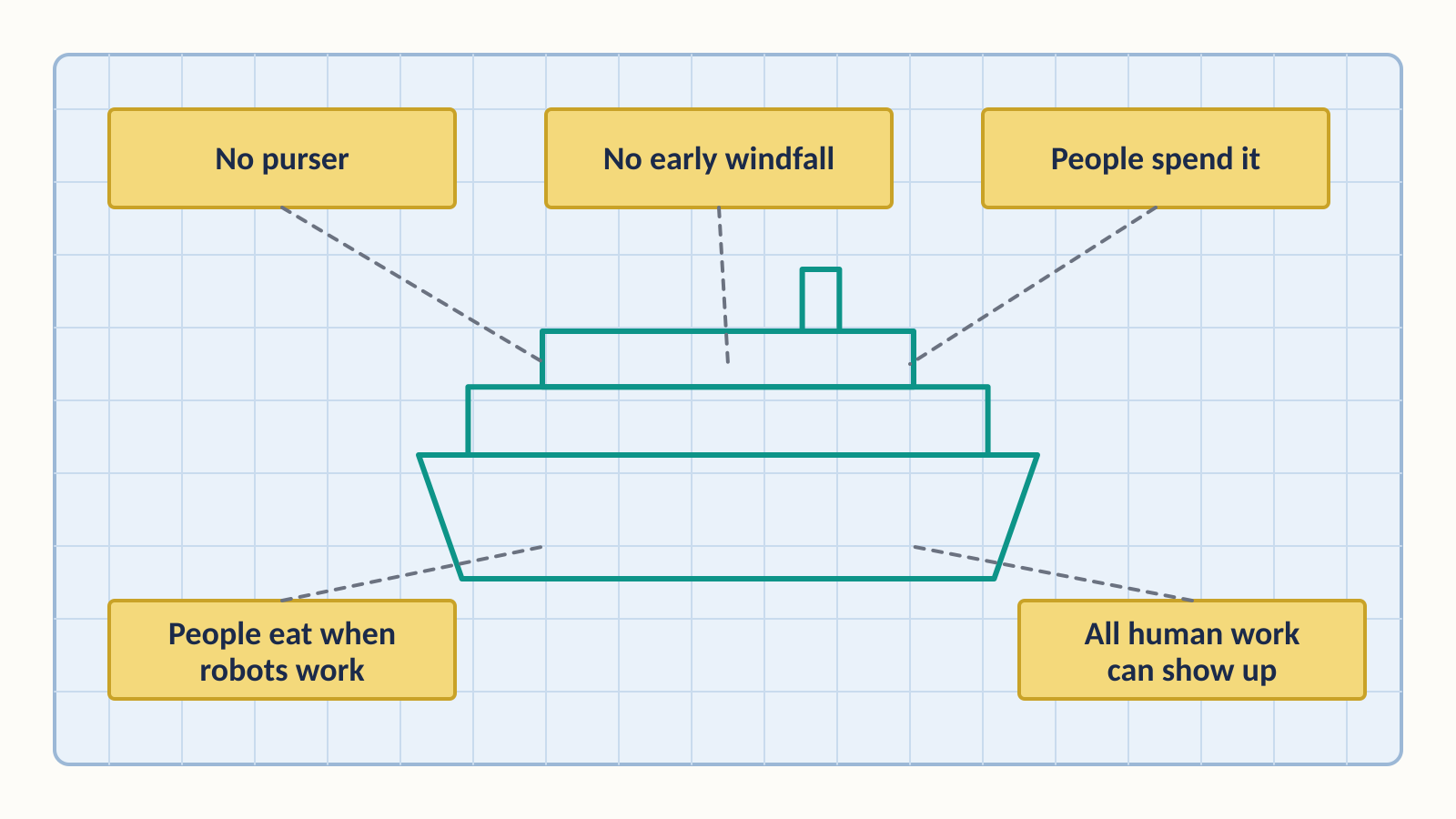
Sketch 31. The blueprint for a new ship.
That's the blueprint. The Alignment Economy is a ship built to it, and it's what I've been working on. Here's how it works.
How the new ship works
Every day on the new ship, every verified person gets 1,440 points, one for every minute of attention they have. It doesn't matter whether you boarded today or ten years ago, and it doesn't matter whether you're a billionaire or a dishwasher. Everyone starts the day with the same 1,440.
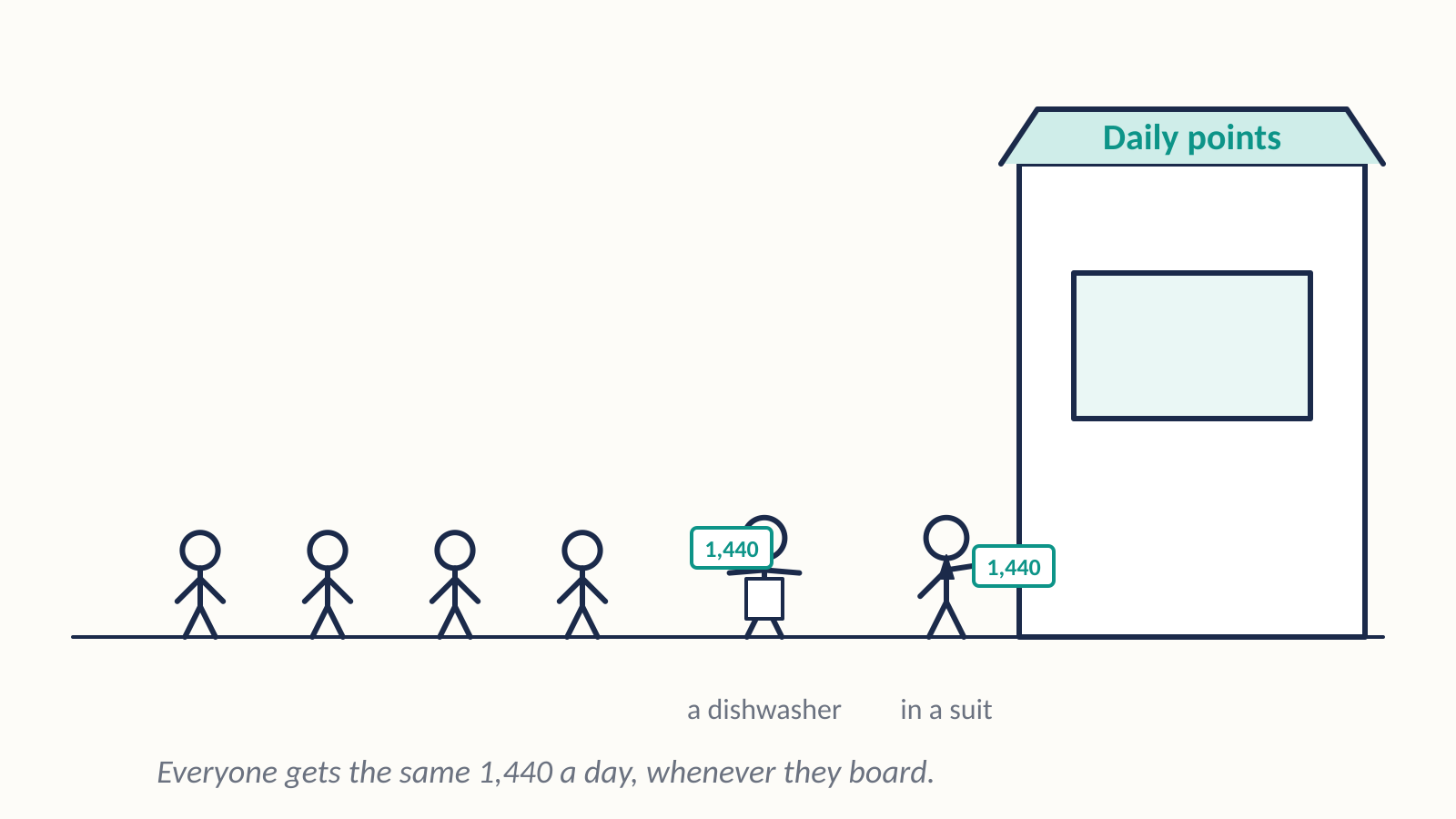
Sketch 32. Everyone gets the same 1,440.
Your daily points expire if you don't spend them, so you use them or lose them. Any points other people send you are yours to keep. That small rule takes care of the hoarding problem from the geek boat. Nobody can sit on their daily points waiting for the number to go up, so people spend them, which means the shops aboard always have customers, which gives people a reason to open shops.
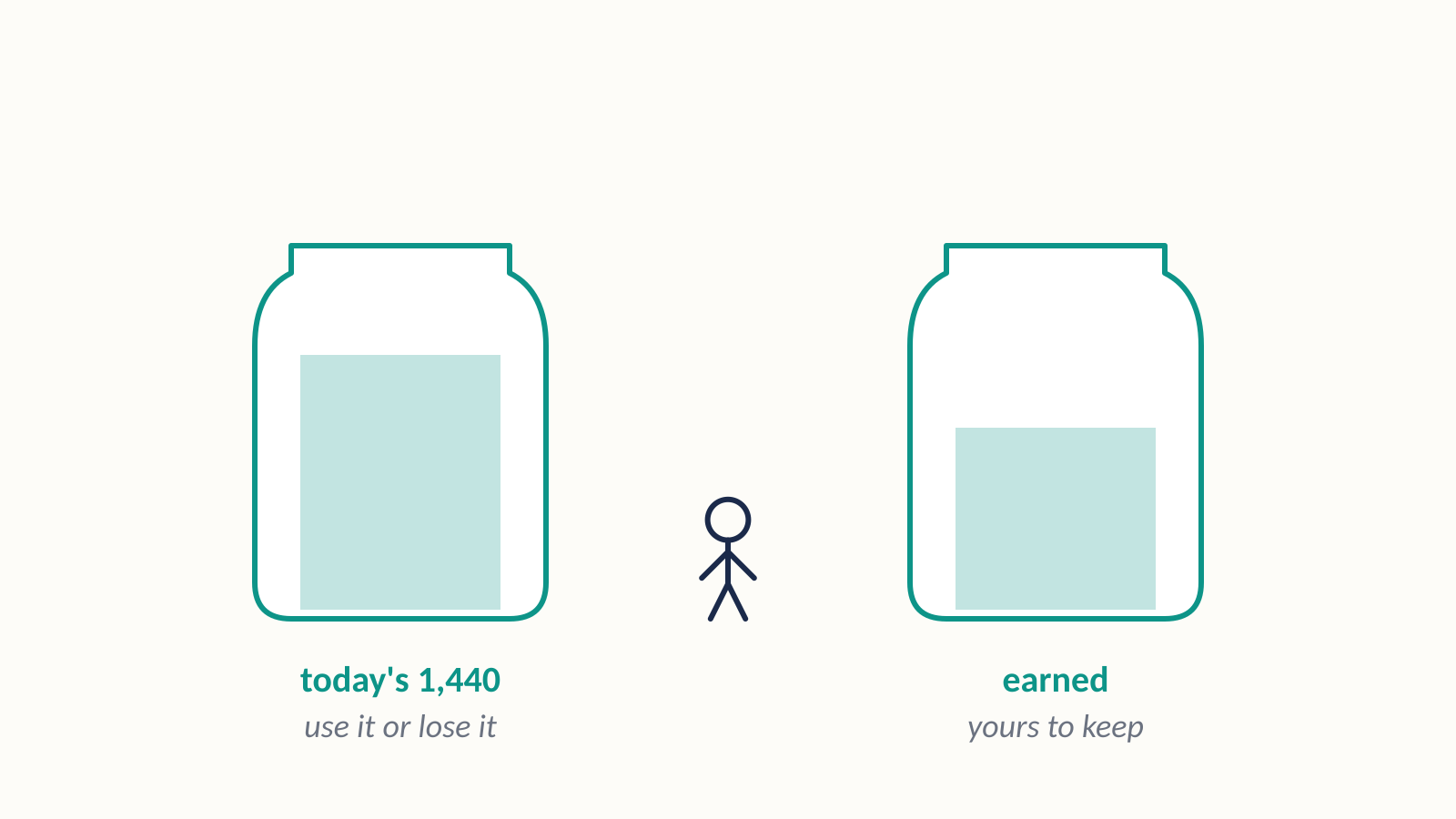
Sketch 33. Use them or lose them, but earned points are yours to keep.
How do you earn points beyond your daily 1,440? The same way you earn dollars today. You do something for someone, they agree you've contributed enough to their needs, whether that's food, shelter, safety, belonging or purpose, and they send you points. The chef earns from the diners, and the teacher earns from the parents. People who contribute more end up with more, just like now.
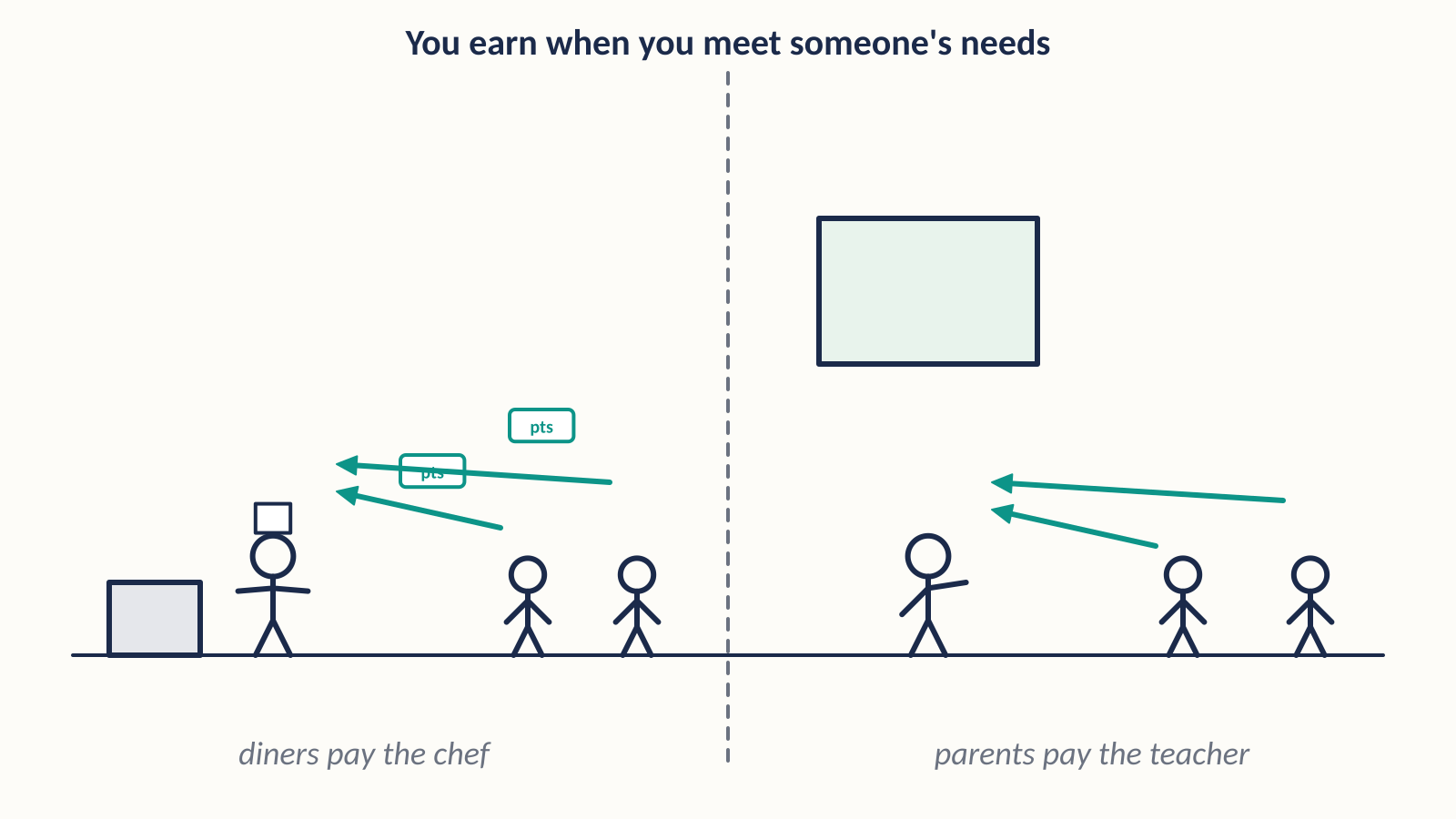
Sketch 34. You earn when you meet someone's needs.
Here's the obvious objection: if everyone gets new points every day, won't that cause inflation? It would, so the system rebases every day. Think of all the points as one big pie. New points get added every day, so the rebase trims every slice by the same percentage to keep the pie from growing. The pie only grows when new people join. The rebase doesn't change how big your slice is compared to anyone else's, so people who earn more points from others still end up with bigger slices.
The rebase doesn't fix prices. A point is worth whatever people will trade for it, and prices will move like they do in any market. What the rebase fixes is the number of points per person, which limits inflation and deflation instead of leaving them to one office with a saw.
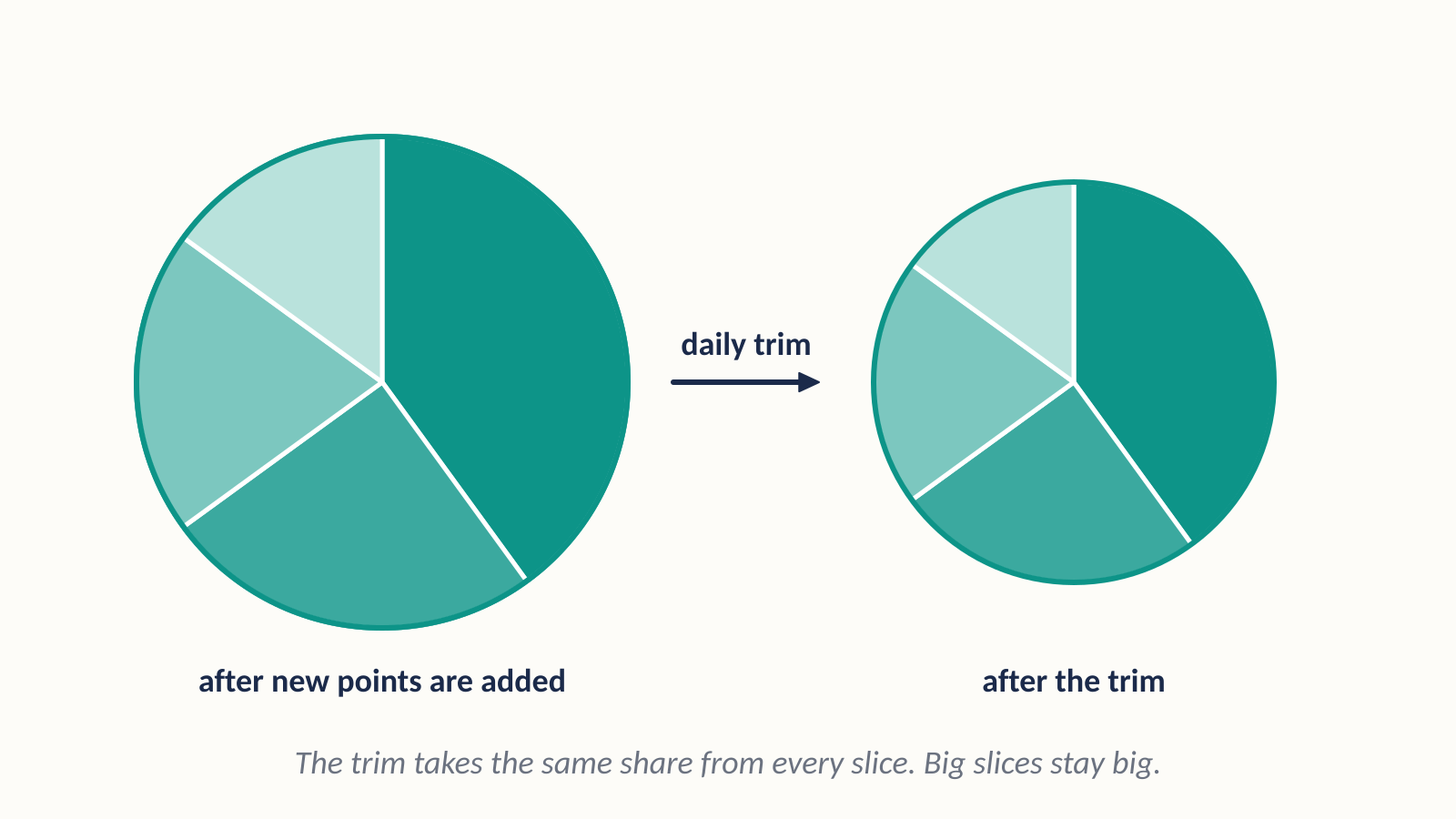
Sketch 35. The daily trim.
What stops the robots from lining up for their own 1,440? Proof of human. Robots can work aboard the new ship, and the businesses that use them can earn points like anyone else, but no robot gets a daily allocation. If this takes off, bots will try to claim points, so miners are incentivized to verify that each account belongs to one unique human. People can choose how to prove it, from friends vouching for them to sharing an ID, and the goal is to make a fake account cost more than it's worth. I'll be upfront that this is the hardest part of the design, and it isn't fully solved yet.
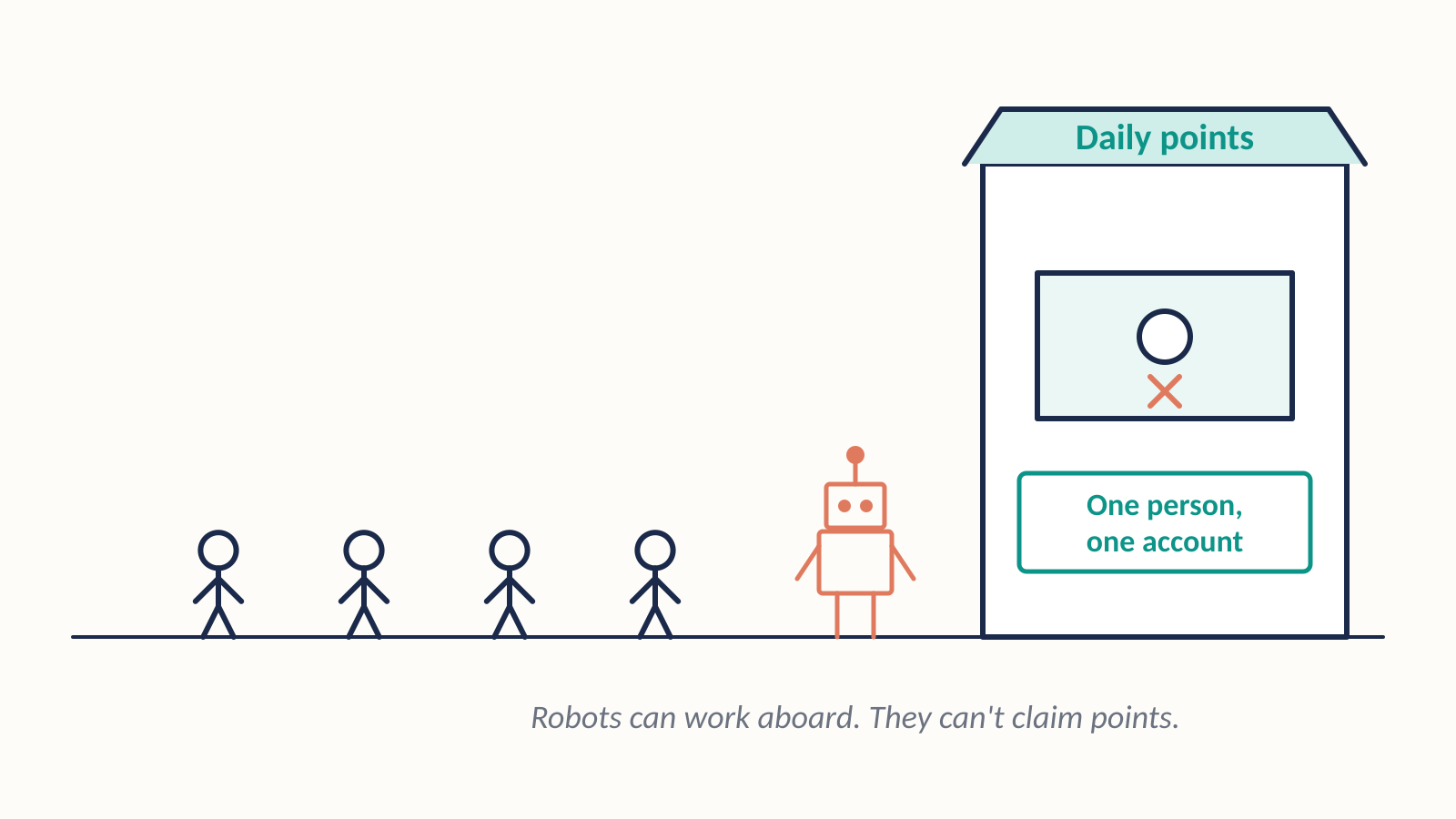
Sketch 36. One person, one account.
Finally, there's no Purser. The rules live in open code that anyone can check, run by many independent computers. Nobody holds a saw, so nobody can quietly cut planks out of the hull.
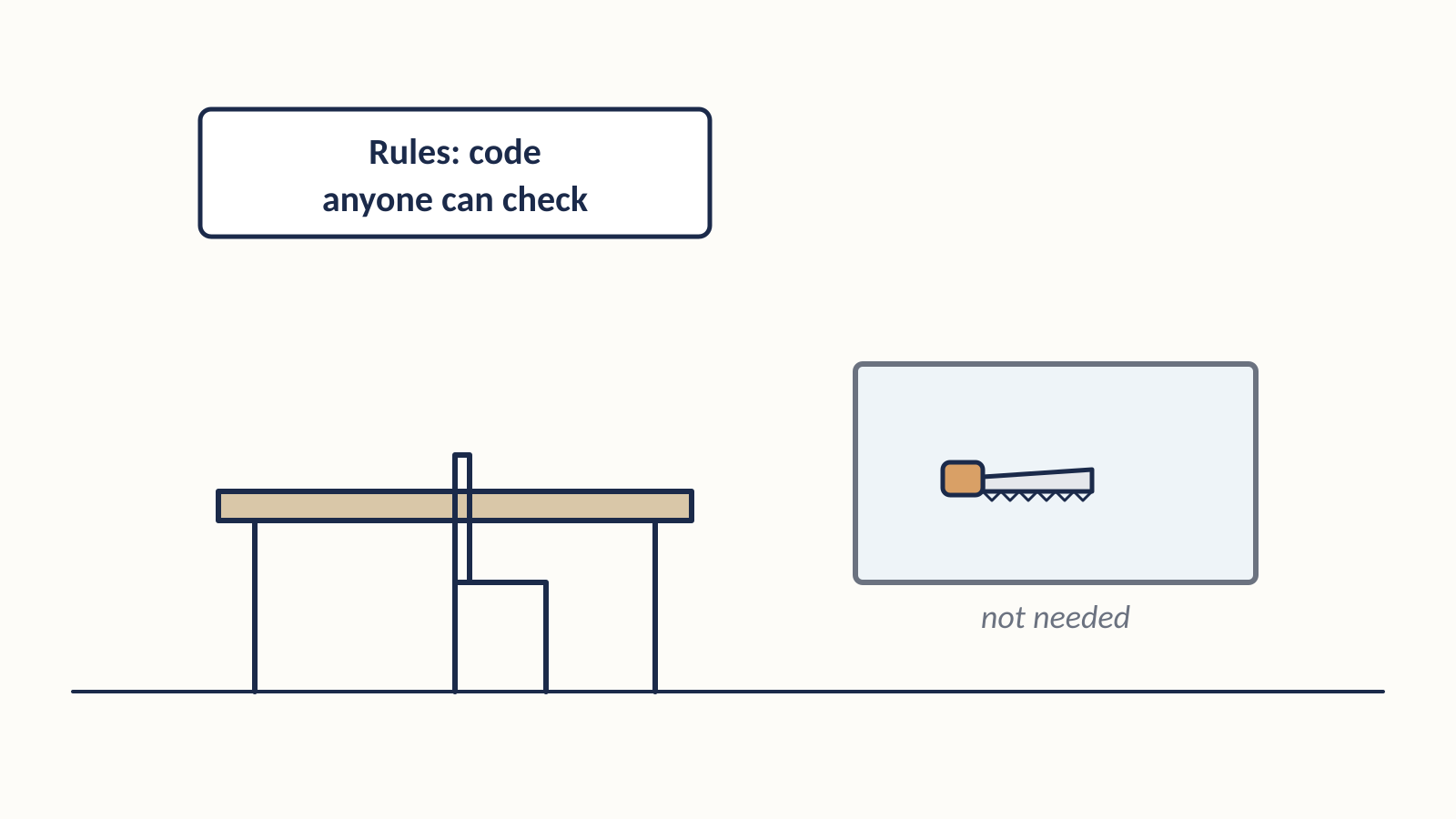
Sketch 37. No Purser, no saw.
Built deck by deck
The new ship isn't a finished cruise liner waiting at the dock. It has to be built, and it gets built the way any community does, from the bottom of Maslow's hierarchy of needs up.
The bottom deck is food. Above that come shelter, safety, belonging and purpose. A deck only really exists when people bring those things aboard and offer them for points: when farmers and cooks accept points, when builders and landlords do, and when teachers and caregivers do. The design helps here, because everyone aboard has points to spend every day, and those points expire if they sit. Anyone who opens a shop on the new ship has customers from the first day.
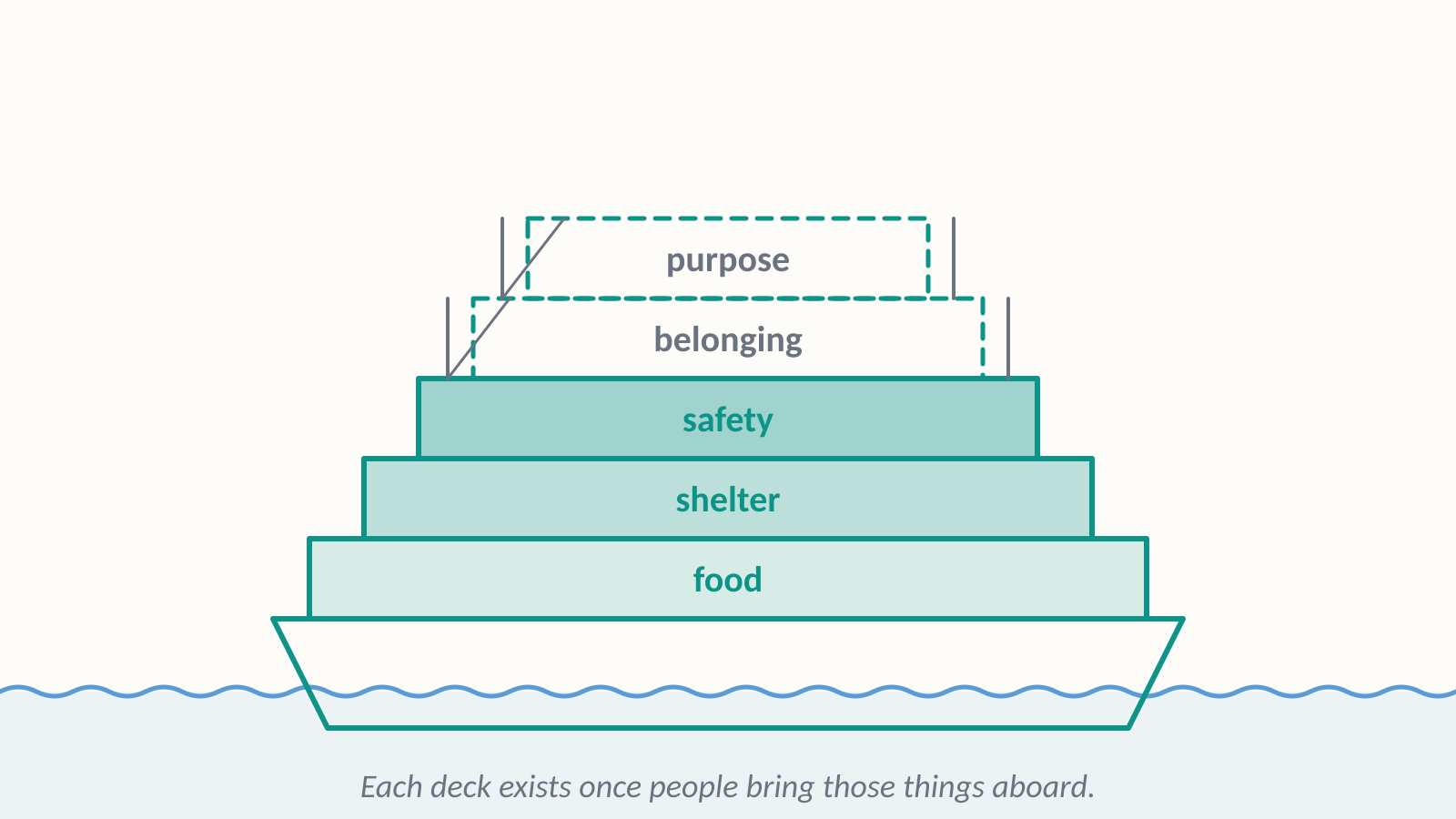
Sketch 38. Maslow's decks.
I want to be upfront about the hard parts, because they're real. Early on, the new ship will have very few shops. People will earn and spend some points aboard and still cross back to the big ship for most of their groceries, and that's fine. Proof of human is hard, and it will have to keep getting better as the stakes rise. And the whole thing starts small, with a few servers, a few builders and a public network that anyone can join and check.
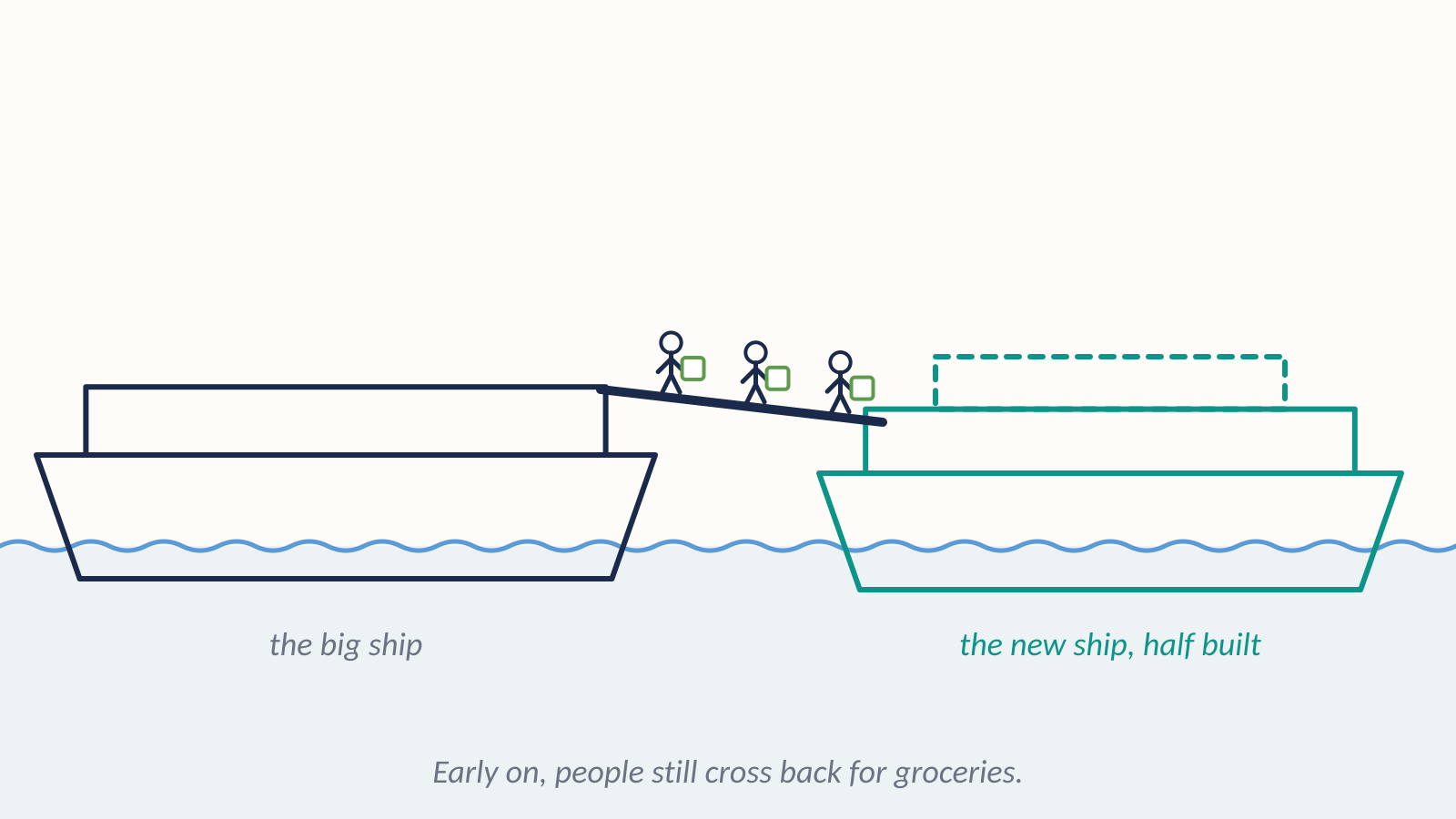
Sketch 39. Early on, people still cross back for groceries.
So the build happens in stages. First, a few builders start the food deck while the old ship still works fine. Then more people come aboard as they bring skills like cooking, teaching, building and caring, and the ship grows a deck at a time. Meanwhile, the old ship keeps riding a little lower in the water.
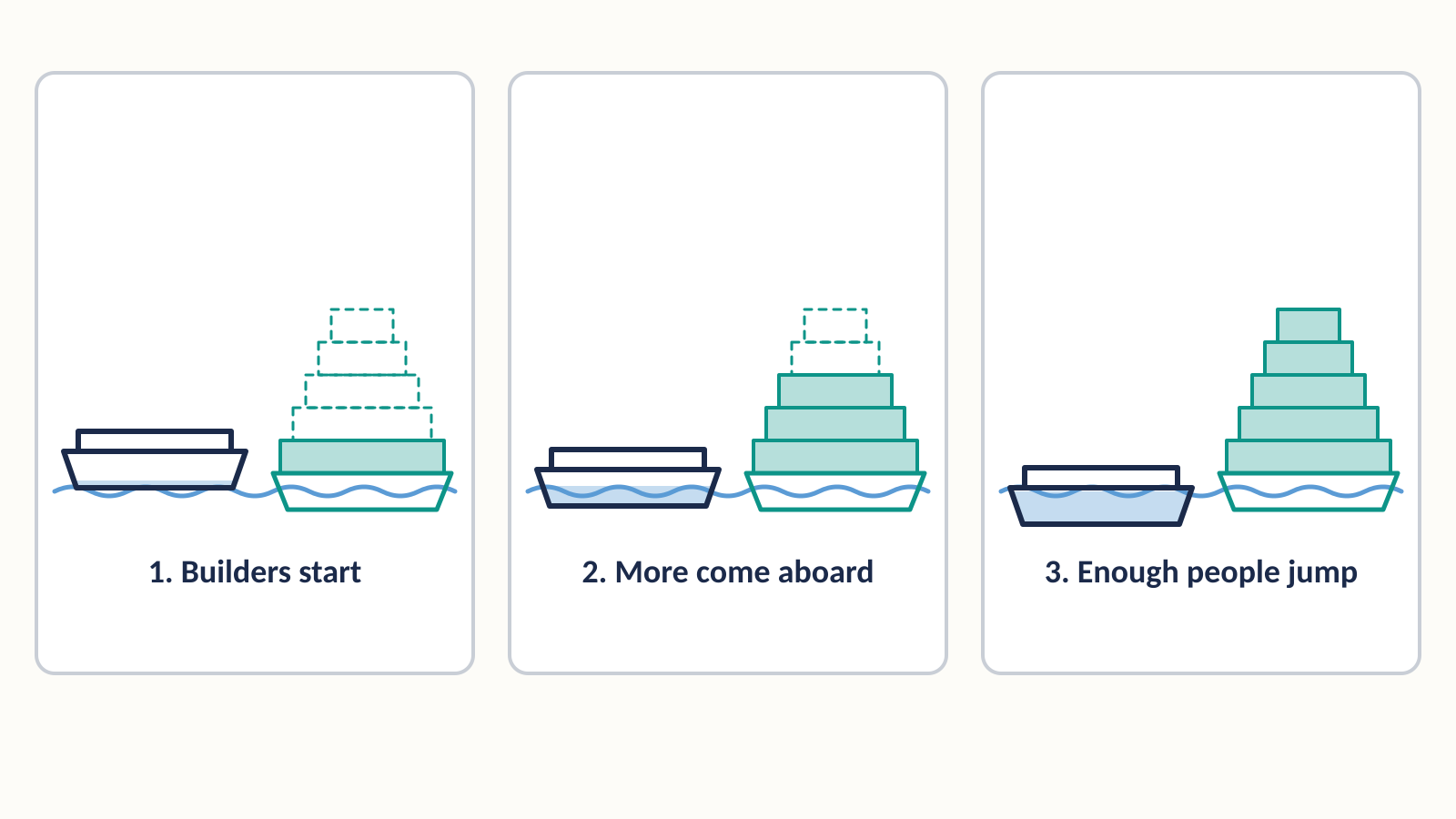
Sketch 40. Built in stages.
The jump, and you
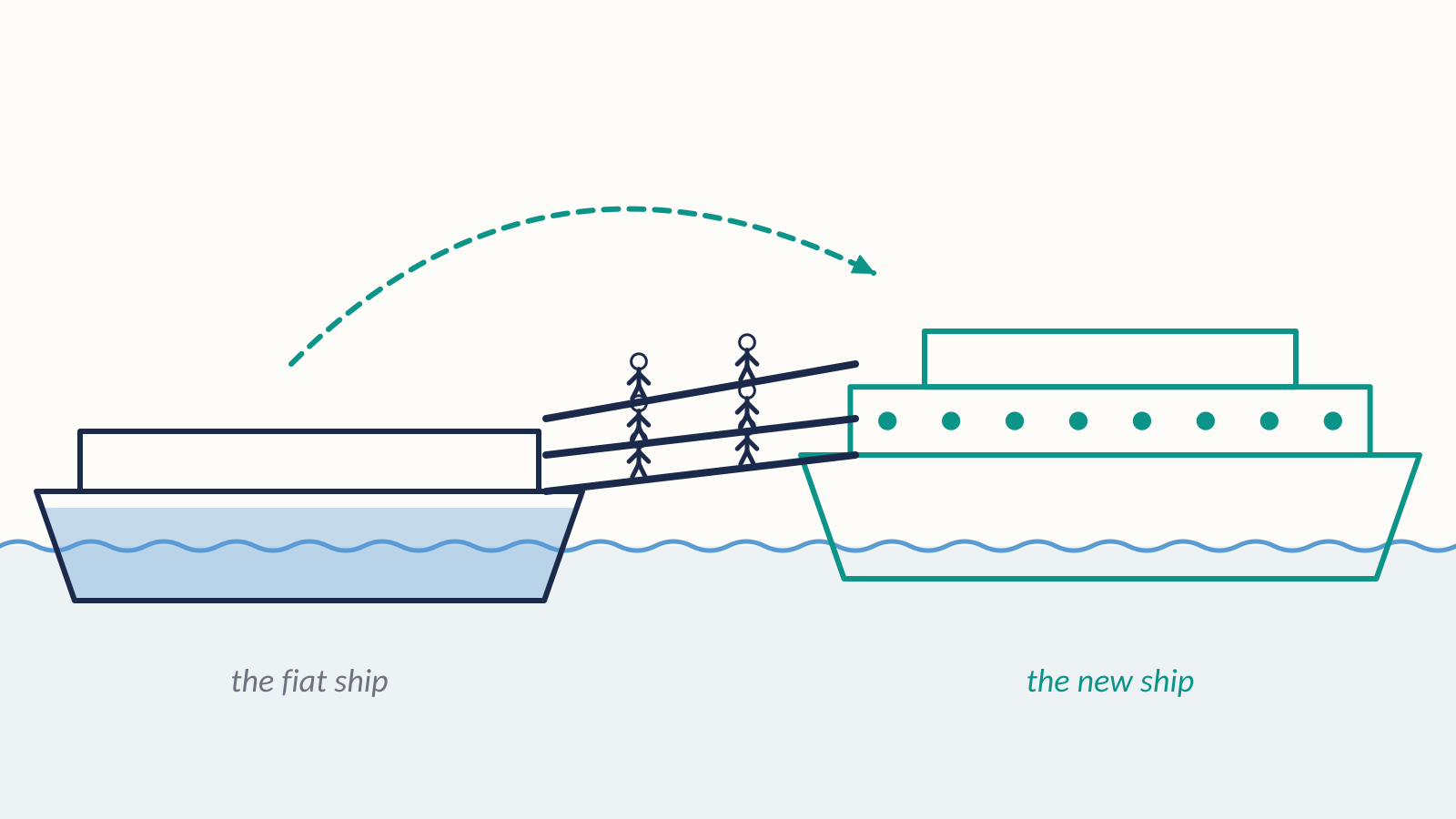
Big transitions happen slowly, then all at once. For a long time the new ship will look small next to the big one, and most people will reasonably stay where the food is. Then one day enough people will agree that the old ship is done, and they'll move, the way people in Zimbabwe moved to the dollar in 2009. When that day comes, the new ship has to already work.
Sketch 41. The jump.
When people do jump, the new ship treats them fairly. Everyone gets the same 1,440 points a day whenever they board. Early joiners don't get richer just for showing up first. Late joiners aren't left behind.
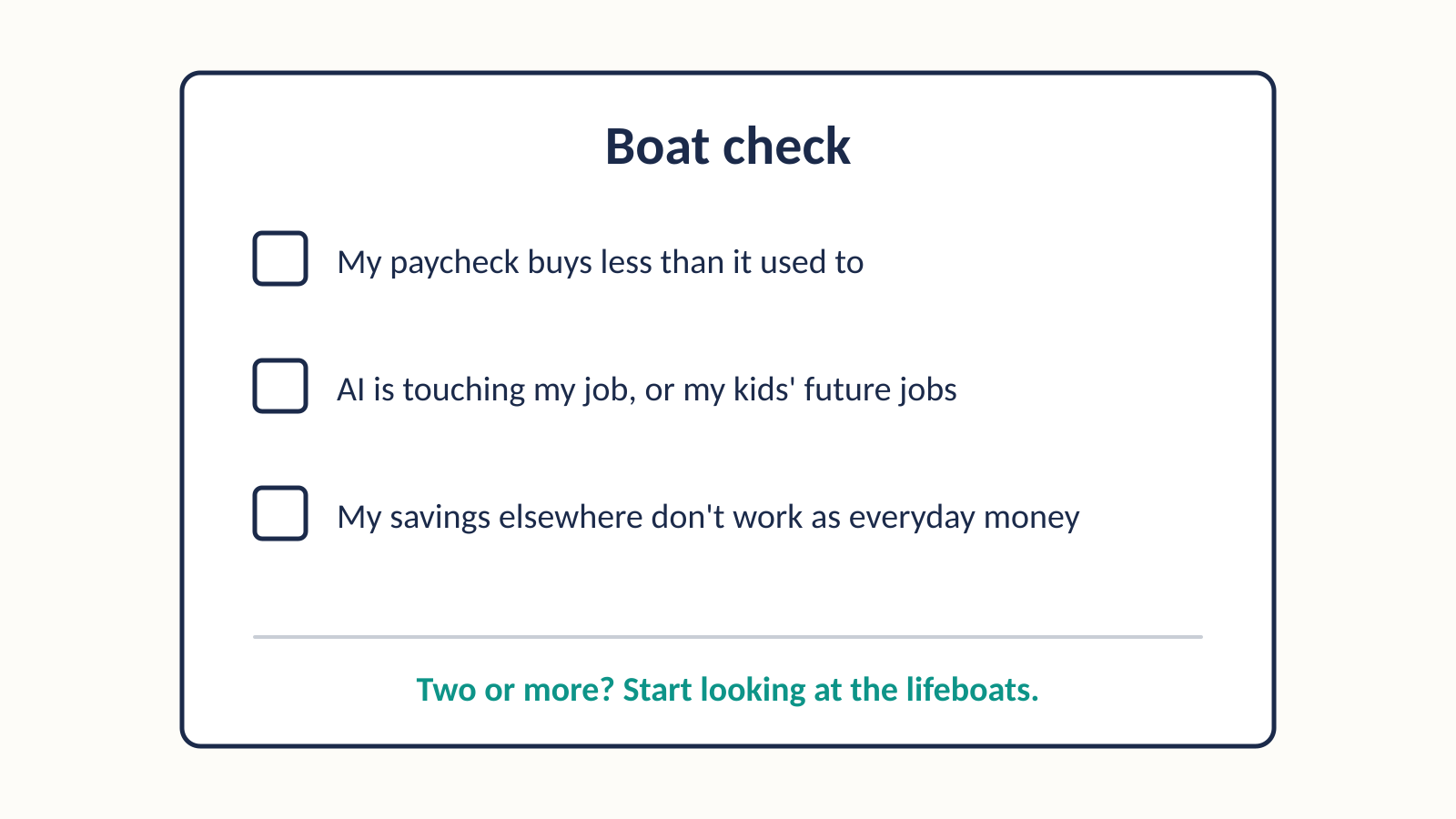
So how do you know when to start caring? Here's a simple boat check. Ask yourself whether your paycheck buys less than it used to. Ask whether AI is touching your job, or the jobs your kids are training for. And ask whether the savings you moved somewhere else actually work as everyday money. If two of those are true for you, it's worth looking at the lifeboats.
Sketch 42. The boat check.
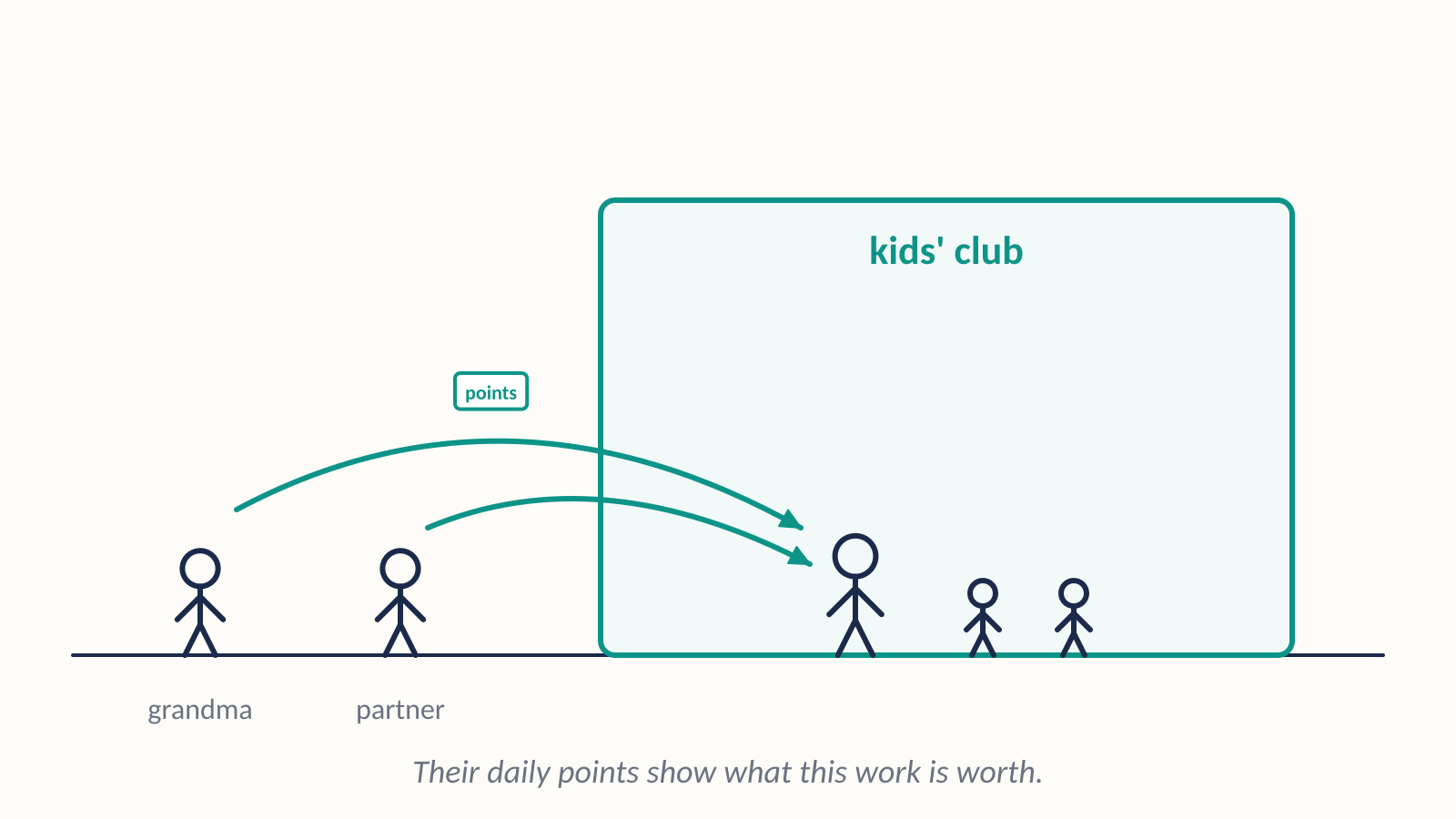
There's one more thing the new ship does, and I've saved it for last because it matters most to me. The old scoreboard never counted some of the most important work people do. Money never paid your mom for raising you. On the new ship, when someone sends their daily points to the parent who stays home with the kids, or to the person caring for an aging parent, that work shows up in the economy for the first time.
Sketch 43. The work money never counted.
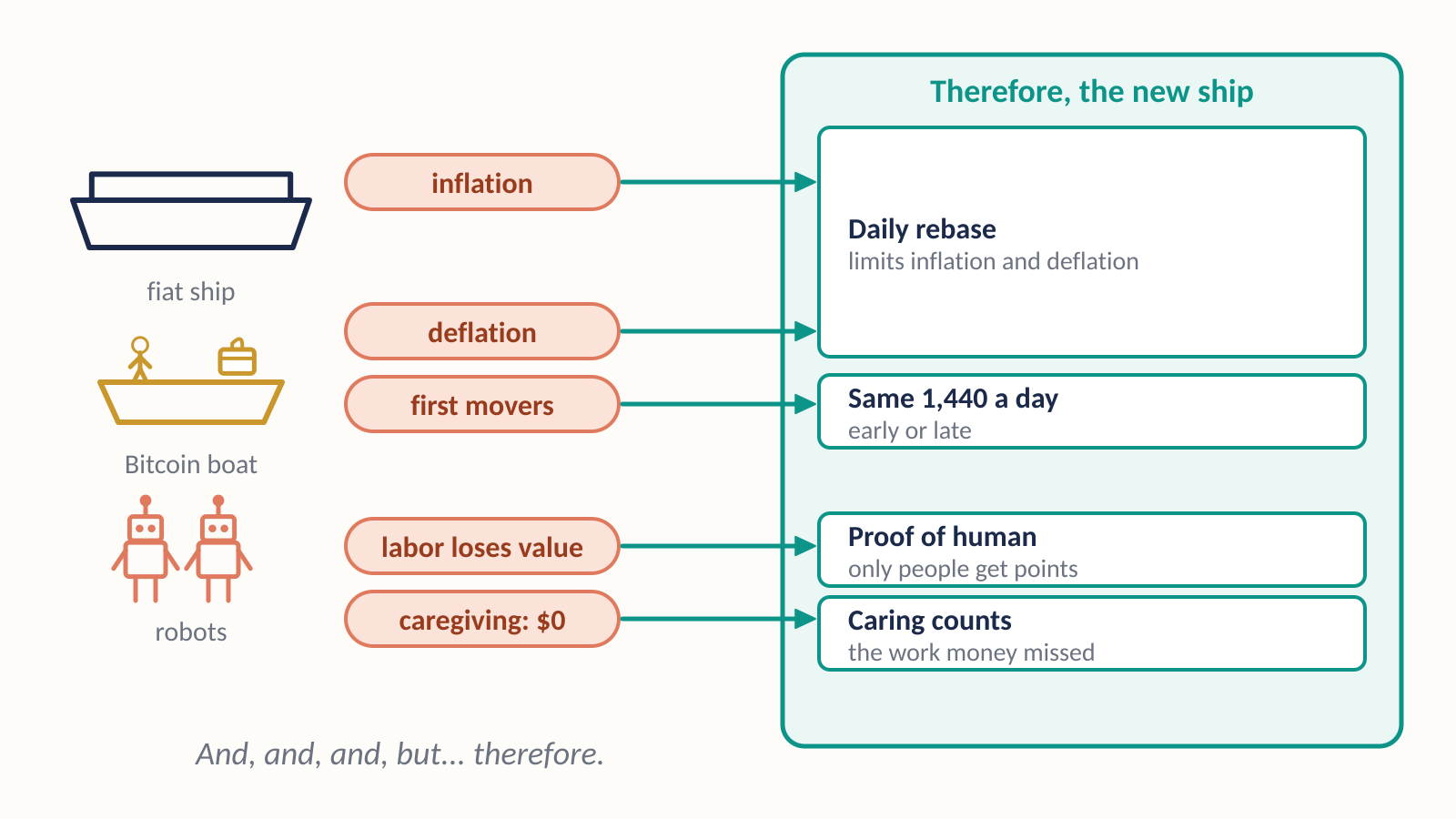
We're building this ship now, and there are three ways to help. You can fund it, so it can get from a white paper to a working network. You can build it, if you're an engineer, a cryptographer, an economist or a marketer. Or you can connect us, because if this isn't for you, the right introduction is as valuable as a check.
Sketch 44. The whole story in one picture.
So I'll end where I started: how are things on your ship?